The Tower

Beefeater

In the heart of London along the River Thames lies one of the most extraordinarily historical places in London. Known as the Tower, it is a complex of buildings dominated by a white castle built by William the Conqueror shortly after the battle of Hastings in 1066. It is an impressive fortification with its moat, narrow winding staircases, and vast rooms. It was originally designed both as a home for the king and a defensive keep. Over time it became better known for the prisoners that were held on the premises and the executions that took place on the green. It is an imposing and improbable complex whose elevations seem both in and out of place in the modern world.

Some time ago I learned that my lineage can be traced back to William the Conqueror and from there to Vikings. I suppose that such is a somewhat dubious honor given that the Norman king was so often resented by the people of England who saw him as a bloodthirsty outsider. Nonetheless his legacy in creating the famous white tower remains as a reminder of the often violent and dangerous history of Britain.

What was once designed as living quarters for the first Norman king has evolved over time in its use, and now stands as a museum and respository of many stories. Visiting the Tower of London is perhaps the most fascinating tour in all of the city, complete with legends about the ravens who have lived on the premises for most of its existence. It is said that as long as they remain Britain will not fall and great efforts are made to keep them happy and willing to stay as permanent residents of the compound.

Countless mysteries and tragedies unfolded in the Tower. Richard II, the protector of his child king nephew, took both the little monarch and his brother there for safe keeping, but they subsequently disappeared thereby leaving the throne to him. Years later when the bones of two children were found buried under a set of stairs it was conjectured that they must have belonged to the long missing brothers. 

It was in that Tower that Anne Boleyn awaited her tragic fate once Henry VIII had decided that she was no longer of use to him. Later she would be publicly executed for treason on the grounds. Lady Jane Grey would serve as Queen for nine days after Henry’s son James died without an heir, and then lose her life when Mary I laid claim to the throne by right of being Henry’s eldest daughter. Elizabeth I would also spend time imprisoned in the Tower but was luckily spared a death penalty and eventually given the throne. Other famous prisoners like Sir Walter Raleigh spent years behind the walls as condemned persons before being put to death.

One of the most interesting areas of the Tower complex is a building in which prisoners left graffiti on the walls. Over time they meticulously carved intricate signs that they had been there. These were no ordinary scrawlings, but rather beautifully carved inscriptions left in the stone for all time. They told of the long days of isolation that the captives had to endure and their determination to leave their mark on history in spite of their wretched conditions.

The Tower complex also features a sampling of the crown jewels including the largest known diamond in the world. It displays goblets and plates of gold, as well as jeweled crowns and scepters. It is a remarkable showcase that points to the wealth of the monarchy and the traditions that have both evolved and continued over time.

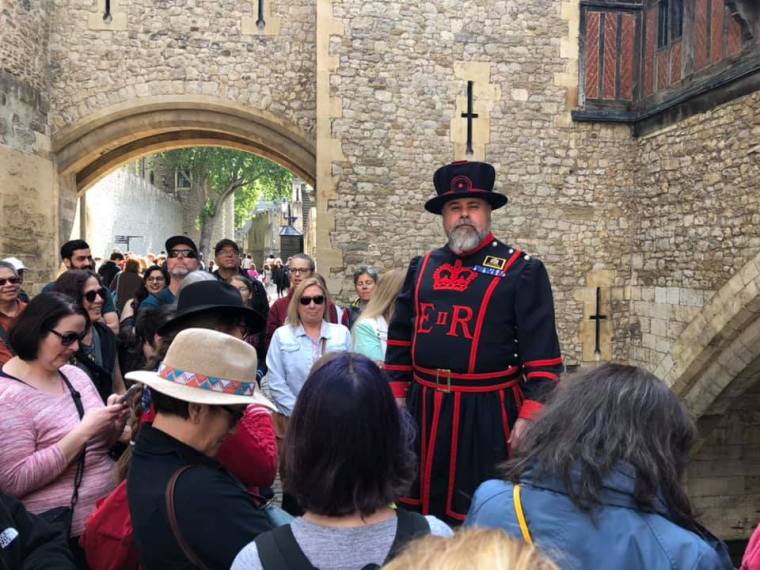
A tour of the Tower grounds includes a rather jolly session with a Beefeater who reveals the history, the stories and the secrets of the complex. The Beefeaters live and work inside the Tower walls and provide visitors with an in depth detail of information. Our particular guide had a rather wicked sense of humor that added to the interest of his tales. He provided a voice to the people who had lived and worked and even died in that fascinating place.

The history of the world is one of violence and tragedy as people fought to gain and retain power. Their’s was not so much a fairytale as a story of intrigue, jealousies, and betrayals. Perceived treason brought imprisonment and death. Choosing sides carried dangers for both noble men and women as well as the common folk. The walls of the Tower of London indeed seem to talk of the fears and horrors of real people who either fought to maintain a hold on their power or suffered because they appeared to be threats. The chronicles of lives celebrated and lost are written in the very stone of this place. There is something majestic, awe inspiring, frightening and evil about what happened within at the Tower making the ravens that act as sentinels seem an appropriate symbol of both the ingenuity and the flaws of humankind.

I left the Tower of London in a rather pensive state of mind. It is a glorious edifice that is a remarkable reminder of the steadfastness and resilience of our humanity, but it is also a respository of our imperfect natures. It is a place where we should surely learn the lessons that history attempts to teach us. Our time on this earth is short in the grand scheme of the universe. The possessions that we accumulate are unworthy of our focus. We will all soon enough become ashes but our actions while still on this earth will have far reaching consequences. Let us hope that we have made good choices and demonstrated honor and integrity rather than greed. The history of mankind is littered with far too much hatred. It is our duty to work toward the good insofar as possible. Power comes and goes and too often corrupts, as we humans continue to work toward a more perfect union of our differences. 

Skye Garden

London is not just about the past. It’s skyline is filled with ultra-modern buildings with unique architecture. Among them is Skye Garden, a thirty seven floor wonder with a three hundred sixty degree glass viewing area. This unusual structure literally appears to be falling forward onto the pavement below, but it is a sturdy structure that provides some of the best available panoramas of the city.

After a long day of taking in the sights of Buckingham Palace and the Victoria and Albert Museum we rode across town to learn what we might see. Because the number of visitors allowed into the viewing area of Skye Garden at any one time is limited, we reserved six spots for the late afternoon. The venue is free, so all we needed were the tickets that we had secured a month or so before our trip. That way we were assured a space without having to possibly wait in a long line.

The ride up to the rooftop area was smooth and we were immediately delighted when the doors opened to an airy garden like atmosphere. Because the days are long in London during the spring and summer months we were in no hurry to make the circuit on the viewing platform, so we paused at the bar ordering our individual favorites among the many wines, ciders, and beers being offered. It was pleasant just sitting and looking over the landscape as far as the eye might see as well as watching the people who were comprised mostly of young Londoners enjoying happy hour after working all day.

We spoke of the things that we had experienced on that day and celebrated our good fortune with weather, knowing that the clear sky would afford us a special look at the city. After a time we scurried out to promenade around the perimeter of the upper floor. What we saw was quite breathtaking and well worth our effort in getting there. There was the River Thames, the London Eye, and the Tower. We were able to point out the dome of St. Paul’s Cathedral and some of the newer structures like the Shard which literally appears to be a pieces of broken glass belonging to some giant. Of course there was also the building formally known as 30 St. Mary’s Axe but better recognized by its nickname, the Gherkin, a silly structure that is often ridiculed with rather insulting monikers.

It was incredible fun to see the city as a whole and to realize the sheer density of the over eight million person population as evidenced in the many high rise apartments. It was also astounding to view the old historical structures seemingly side by side the more modern buildings. It seems that Londoners honor both history and progress.

There is a lovely restaurant at the top of Skye Garden but it was a bit much for us on that evening when we were growing a bit weary from our many adventures, so after taking multiple photos and marveling at the beauty both inside and outside the glass platform we decided to head back to our hotel in Bloomsbury.

By this time we had already grown fond of the pub inside the Holiday Inn which appeared to cater to more locals than tourists. We had already made friends with several of the people who came each night to visit with one another, watch some football and drink a bit of stout beer. We ordered some great pub food and set up a game of Jokers and Marbles, a strategy game that is a cross between Sorry and Parcheesi.

We played in teams of women versus men. In a three out of five tourney that lasted for more than a week the women were the victors. More importantly was the laughter and fun that we enjoyed of an evening as we gathered around a huge wooden table sipping on brews and snacking on pub food like bangers and mash, fish and chips, meat pies, onion rings, or soup with bread. It was a great way to get to know the people from the neighborhood and to sample some of the traditional food and drink. Over the course of our trip we grew to look forward to the leisurely evenings in Callahan’s Pub.

We had already experienced so much of both the old and the knew in London. We had been dazzled by the rich history of this city and delighted by the friendliness of the people that we had encountered. We felt right at home in the hotel and on the Tube. In fact, I was greatly impressed by the polite behaviors that I continually encountered. Each time I entered a tightly packed train car there was invariably some young man wanting to surrender his seat to me. It was nice to see such mannerly behavior to be called “Mum or Mother” out of respect. I was very quickly learning to love this city and its people.

Victoria and Albert

Victoria and Albert

Until the reign of the present day queen, Victoria had held her office longer than any other monarch in the history of Britain. Her influence on Europe and the world was enormous and the story of her relationship with Albert became the stuff of fairytales. She was the transitional figure between the nineteenth and twentieth centuries, seeing and bringing changes to the country that brought the nation into the modern world. Her children and grandchildren had a profound effect on history in two major wars and their impact continues into the present day. We all seem to have a kind of fascination with Queen Victoria, and in particular her consort, Prince Albert.

Victoria and Albert were first cousins who fell in love, married and together had nine children. Albert’s influence on Victoria was enormous and while she clung tenaciously to her own independence as a monarch she supported many of his ideas for modernizing the country that she ruled. He was a somewhat forward thinking man with varied interests that kept him continually engaged. After his death Victoria went into a state of depression and mourning, never again wearing anything but her widow’s weeds. 

After watching the changing of the guard at Buckingham Palace our group traveled by Tube to the Knightsbridge area of London where the Victoria and Albert Museum is located. The station exit revealed a lovely neighborhood filled with trees and refined looking buildings. Only a few steps away was the museum that we were seeking. It is an imposing structure that opened up into a decidedly open and airy hall once we were inside. It showcases a cornucopia of art, sculpture, textiles, furnishings, ceramics and decorative pieces. Founded in 1852, the museum was named for the queen and her husband. It houses a permanent collection of more than two million objects, and best of all there is no charge to see most of the works of art.

After first stopping for a brief respite and a small snack we wandered from one section of the building to another delighting in the glorious sampling of art that was on display. I was particularly taken by one hall that featured works by Rodin and other sculptors. We enjoyed watching a young woman creating a pencil drawing of one of the sculptures. She told us that she had been working on it everyday for weeks and she was in hopes of completing in on that day. She mentioned that many artists find inspiration at the Victoria and Albert, and I too felt that there was a lively spirit to the place that made it something more than just a repository for old things.

I was particularly taken by an entire hall that featured the craftsmanship of Islamic artists. The rugs, textiles, vases, bowls, and woodcarvings were so delicate and uniquely colorful. They seemed almost to have been crafted by heavenly personages rather than humans. There was a lightness about them that was otherworldly. I was transfixed by the beauty and found a kind of serenity in simply gazing at the various objects.

Another room was set up to show the clothing and furnishings of various eras. It was so interesting to the trends and the fashions of each historical period. I found myself marveling at how small the sizes were compared to what we use today. We humans have certainly grown larger over time thanks to the abundance and variety of food that is now available to us. The everyday diets that we take for granted were once the domain of only the wealthiest, and even they did not enjoy the miracles of interstate commerce that bring us delights from all over the world.

As someone who has always loved fashion I delighted in a room that featured women’s clothing from different eras and decades. I am old enough to have remembered the lovely fitted dresses and suits that the women wore in the nineteen fifties and the mini-skirts and mod styles that I donned in my college days at the end of the nineteen sixties. The styles that were featured were so lovely and amazingly so classic that if someone were to wear them today they would no doubt look quite fashion forward.

The museum complex features a large splash pool where youngsters played excitedly while their parents watched with unadulterated joy. I smiled at the relaxed and lively spirit of the place where every person seemed to have a contented smile permanently affixed to his/her countenance. I imagined that Prince Albert in particular would have been quite proud that even us common folk were able to view so many treasures. I felt so welcome and so relaxed there and might have stayed far longer but for the fact that we had a reservation for Skye Garden and needed to depart.

I spent my last moments in the gift shop which was the most wonderful of all such places in London. I purchased two tea towels crafted from extraordinary patterns. I plan to use them whenever I have a tea time with my grandchildren or my niece. I also chose an apron that was so lovely that I can’t imagine actually using it while cooking. Nonetheless it will be nice to don at the last minute for the Sunday dinners and special occasion extravaganzas that I so love to provide to family and friends.

In a single day I had mulled over the long history of England and the role of royalty in the modern world. Somehow the Victoria and Albert Museum had helped me to understand the symbolic significance of the monarchy. I suspected Victoria and Albert’s influence in making more recent kings and queens more caring about the people. I felt more and more kinship with the idea of having a royal presence and I somehow began to realize what the Queen represents. 

A Walking Timeline Through History

Trafalgar Square

When the best laid plans go awry, pathways to new adventures often show themselves. We were to have spent our morning watching the changing of the guards and our afternoon at Westminster Abbey. The cancellation of the tradition of pomp and circumstance at the palace had sent us scurrying to the Gothic church far earlier than intended, so once we were finished with our tour we became untethered and aimless wanderers around London.

The roads almost inevitably lead us past the halls of Parliament where protests centering on the Brexit issue were a constant feature during our time in the capitol city. We glanced disappointedly at Big Ben which was shrouded by the apparatus of reconstruction save for the face which never changed because it was not working. We wondered as we longed to hear the famous chimes if somehow all of our planning was doomed to go up in flames, but we soldiered on, walking past a highly secured area that housed the home of the outgoing Prime Minister.

There was much stirring behind the gates. We saw official looking men wearing formal  jackets filled with medals leaving the premises with grim expressions. It told us that Theresa May was no closer to creating a plan for transitioning Britain from the European Union to a  more nationalist entity. There was a noticeable tension in the air that hovered over the halls of government and the silence of Big Ben added a metaphorical touch to the chaos.

After walking for what had seemed like many miles Trafalgar Square was in view and husband Mike became quite animated by the thought of seeing the iconic tribute to those who had fought so valiantly in World War I. First, however we would pause for lunch in a nearby pub where I admittedly struggled to find something that appealed to me on the menu. I generally eat a very light midday meal and there was very little of that sort to be found among the traditional English food being offered, so I essentially skipped eating and instead enjoyed a lemonade and a much needed rest for my feet. I used the time to find and purchase the tickets that we would use later that night to see the choral concert at Westminster Abbey.

Once everyone was refueled we headed to Trafalgar Square which was quite joyfully bursting with life, mostly from tourists and street artists. The atmosphere reminded me of the area around St. Louis Cathedral in New Orleans, Louisiana. There were accomplished musicians and singers entertaining the crowd with performances worthy of Albert Hall. Using only chalk and their imaginations many individuals drew masterpieces on the grand sidewalks of the square. A gigantic fountain surrounded by enormous lion sculptures served as a photo opportunity for everyone who passed by, and of course there was the famous obleisk honoring the courage of those who defended the nation in World War I.

This was indeed a happy area where the tension surrounding the government buildings was replaced with a kind of serendipitous celebration of art and humanity. It felt good to be there and somehow made up for the botched intentions of our morning. We all realized that while we had not achieved what we had planned, we had stumbled upon something that was nonetheless glorious.

Just beyond all of the revelry lay the National Gallery which like so many sights in London was open to the public at no cost, so we decided to partake of its vast collection of paintings and sculpture in the time remaining before our evening engagement. This would prove to be a wonderful decision because some the the most famous artists the world has ever known were featured in the multi-story galleries.

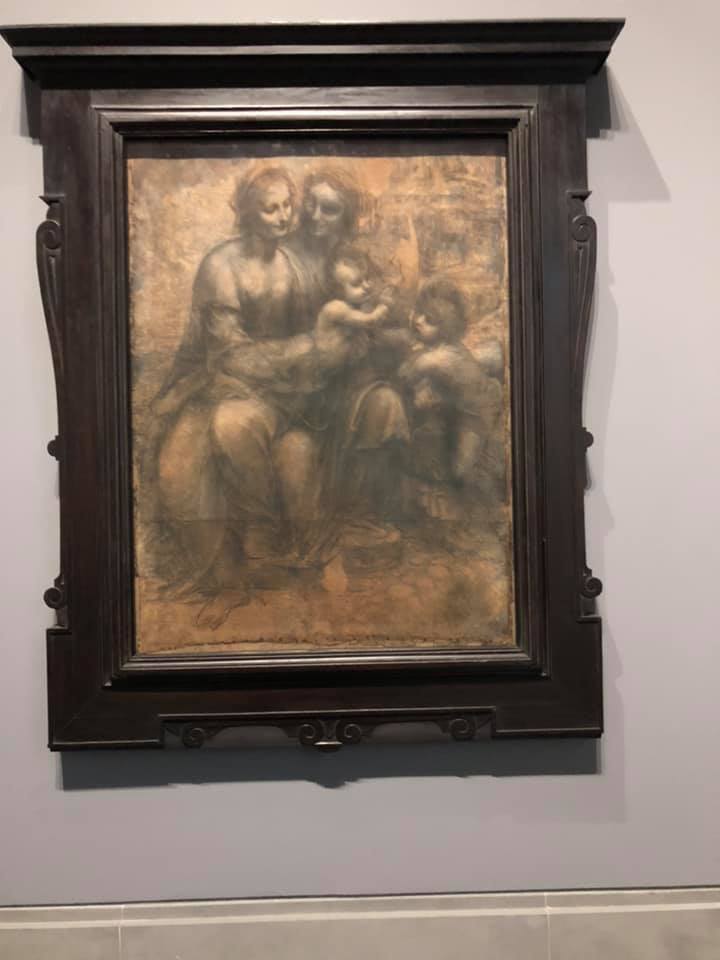
I enjoyed so many of my favorite painters and was filled with appreciation for some about whom I had known nothing. Without a doubt, however, the experience of wandering without warning into a room containing the work of Leonardo da Vinci was the highlight of the visit for me. The funny thing is that I had spied his drawings from out of the corner of my eye and had noted that I felt drawn to to them before I realized that the great master had created them. There was a kind of lively charisma to even the preliminary sketches that elevated the pieces to a level unmatched by any of the other artists.

I might have stood transfixed in that room for hours were it not for the fact that we had agreed upon a meeting time in the coffee shop, and that hour was drawing near. It was with great reluctance that I took one final glance at the glorious paintings and headed down to meet with the rest of our party.

We enjoyed a bit of respite and a great deal of animated conversation over steaming cups of Earl Grey tea as we spoke of our favorite works of art. We all agreed that we had somehow been led to a most enjoyable afternoon by the “gods of travel” and we promised that if we had some additional time later in our trip we would gladly return to this wondrous place to be certain that we had not missed anything.

When we emerged into the late afternoon air we saw that the festivities taking place in Trafalgar Square had not abated. It seemed to be an oasis of cheer and goodwill which was perhaps the intent when it had been designated as a memorial to all that is good about Britain. After the horrors of World War I the citizens needed to remember, appreciate, and celebrate the many sacrifices made. I thought it fitting that the joy of peace time was still very much in the air.

We walked away with an even greater sense of the spirit of London and its people. In a single day we had looked far back into their history and gazed at the gravity of their present. It had been like walking a human timeline during which we witnessed the resilience of the people. We realized that they had made mistakes before, and perhaps were enduring them even now, but always they seemed capable of adjusting their course and moving on the right side of history.

Wonders of the World

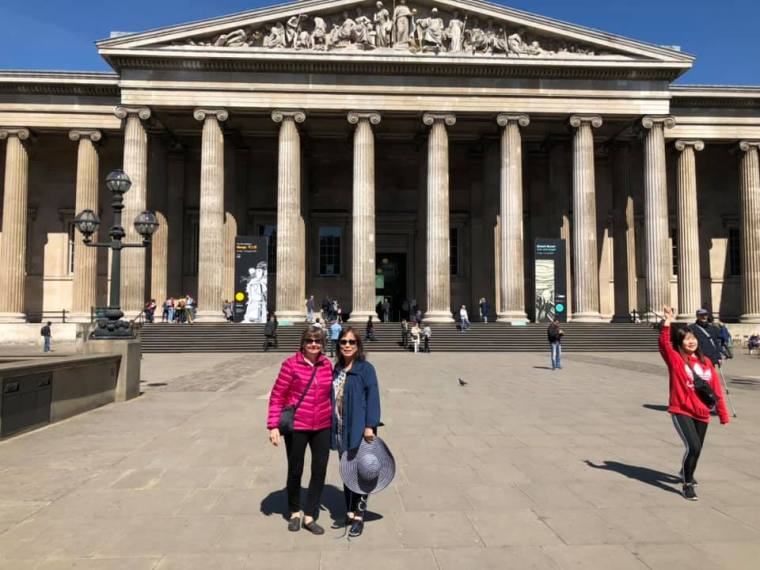
British MuseumThe Bloomsbury area of London is the home of the university of London, Kings Cross Station, and the British Museum. A short stroll in almost any direction leads to lovely sights. In May the gardens and window boxes are filled with lovely flowers of every hue. Tiny markets offer fresh fruit and sweet bouquets. It’s a pedestrian world in which the sidewalks are filled with walkers strolling more leisurely than in the heart of the city. It is a place where lingering just a bit longer is in fashion.

On the first full day of our trip we chose to eschew hurry, and instead enjoyed a scrumptious English breakfast buffet in our hotel. We feasted on fried, scrambled and poached eggs with little English sausages, baked tomatoes and sautéed mushrooms. We enjoyed steaming pots of Earl Gray tea or tasted the brew from the latte machine. Crusty loaves of bread beckoned us and a bounty of pastries were ours for the taking. We had our choice of cereal and fresh fruit, cheese and pancakes. It was a good way to start our adventures for we would walk ten of thousands of steps, many miles in a single day.

Our quest was to visit the British Museum about which we had long heard. The building in which great treasures are housed is an imposing structure which would be worth a look even without ever going inside. Once we had entered we were in awe of the great halls and sensed that we were about to see magical things that we had only before read about in books. After gathering and studying a map we decided to go first to the Egyptian section where we were immediately taken aback by the presence of the Rosetta Stone, an imposing treasure that would have been worth the trip all by itself. 

From that first moment we were in awe of the treasures that were displayed for what seemed like miles. It was difficult to know where to first look or what direction to follow. The trove of artifacts was so expansive that it gave me the feeling of being an adventurous archeologist who had suddenly stumbled upon a great find. I felt humbled as I gazed at items so exquisite and so old that I had difficulty processing an image of the creative and skilled people who had made such things in a time when tools were simple and scarce. I found my mind going far back into the history of mankind, and I marveled at the human connections that I felt with the people who had left such incredible marks on the world. I also thought of those who were simply nameless persons attempting to deal with the challenges of living, often under great duress.

I was brought back to present day reality only when I saw a group of young school boys careful taking notes about what they were seeing. They were so cute in their jackets with crests on the breast pockets and their earnestness in deciphering the mysteries of the many artifacts that they passed. I suppose that I will always love children and feel proud of the tiny contribution that I have made in the long range history of a generation. I think that we humans create because we have always desired to find some kind of purpose to our existence,

I was so caught up in seeing Roman statues, Greek urns, and Chinese porcelain that I hardly noticed that six hours had passed and it was time to enjoy a traditional afternoon tea gathering. Our group ate little sandwiches filled with chicken, salmon and eggs. There were scones and cakes and tiny cookies. We relaxed and chatted about what we had seen and how we felt. We worried just a bit about how so many things had been brought to Britain from the places where they were found. We wondered if they had simply been confiscated or if there had been permission, agreements, and payments for taking such things. I suppose that there are many different points of view as to the ethics of having such museums, particularly when the items include actual mummies. Is it wrong to raid a sacred tomb, or should we honor the purpose of such rituals by leaving them intact?

After refueling ourselves and debating the pros and cons of how and whether or not we were somehow complicit in the rightness or wrongness of such a museum we continued our study of the many different rooms. We saw Mayan carvings, and intricate woodworking from Abysinnia. We walked past glorious creations from India and Japan. Our heads were swirling from trying to read the descriptions of what we saw and achieve some kind of understanding of the magnitude of the glories of each culture represented in space after space.

Soon it was nearing five in the afternoon, and we realized that we had literally spent an entire day mesmerized by what we had viewed. Nonetheless there was still more to see, but that would have to be for another day, perhaps on another trip. The doors were closing and we were explorers forced to reluctantly set our adventures aside.

Russell Square near the museum was by that time filled with tourists and locals enjoying the coolness of the afternoon under enormous trees. They lolled in the grass and sat smiling on benches. There was an unspoken collegiality between all of us as we exchanged smiles and greetings. We felt as though we welcome in this place and it felt so good.

We finished our day in Callahan’s pub in our hotel. We feasted on a variety of food. I chose bangers and mash which were as tasty as I had hoped they would be. I enjoyed a nice glass of wine while my travel companions chose ciders and beers. We played a game on a large table and watched soccer on the television above our heads. We got to know some of the locals who came to the pub of an evening just to have a swig and a bit of conversation. It was a fun closing of a perfect day in Bloomsbury in London town.