Inventing a New Way

selective focus photography of left hand on top of right hand on white pants
Photo by rawpixel.com on Pexels.com

When I was growing up I knew a number of elderly people who lived with their children who cared for them until the day they died. It wasn’t all that unusual to see households composed of extended family members. My own maternal grandmother lived with her two bachelor sons and the rest of her children often took turns sitting with her whenever she became too sick to leave her bed. She died peacefully in her home with her loved ones hovering over her.

My husband often speaks of his grandmother and mother caring for his great grandmother who had been struck down by a stroke. It was an exceedingly difficult task because the woman was unable to move on her own and she had become chronically irritable because of her afflictions. He often heard her screaming at the ladies who attempted to tend to her every need. They understood that she was the victim of her circumstances, but that knowledge didn’t make their task any easier.

By the time I became an adult the idea of having several generations living under one roof seemingly went out of style. I only knew of a couple of people who opened their homes to elderly relatives. One was a very compassionate neighbor who lovingly cared for her invalid mother-in-law. It was hard work because the woman could never be left alone. One time I went to help out by sitting with the sickly lady, and I was physically and mentally worn out by the end of the session. 

I had one other friend whose mother lived with her, but the older woman in this case was healthy and energetic and helped greatly with duties around the house. I used to love visiting their home because the two women laughed and joked with one another constantly and always offered me fresh cookies that they had baked together. They made their somewhat unique situation seem almost idyllic.

Eventually my own mother spent a little more than two years living either with me or my brother. She was in relatively good health, but her mental difficulties required more and more monitoring as she aged. She and I both struggled with the enforcement of her daily medication intake. She felt that I was overstepping my bounds, and I felt beset upon by the battles that ensued each day. If it had not been for the clash of wills, I would have viewed her time in my home with great joy. I liked having her at our dinner table each evening and talking with her about my work day. She possessed a kind of folk wisdom that helped me, and I valued her opinion. She appeared to be doing very well while in my care, so it was shocking to learn that she had lung cancer. In fact, I was reluctant to believe that she was as sick as she was. I’m still happy that I was able to provide a safe and loving place for her until the very last few days of her life when she had to go to the hospital. 

The number of elderly individuals no longer able to take care of themselves without some supervision will continue to grow as the “Baby Boomers” enter their seventies and eighties. The question becomes how our society will be able to adequately care for those who require assistance in their daily routines. There are already a number of companies that are creating technologies that may support the younger generation in dealing with the coming surge.

Of course there are some people whose illnesses require twenty four hour care. Nursing homes will no doubt become crowded, but what I know from friends is that they are not the only answer. I know many people who realized that their parents needed to be in a more professional facility than their homes, and then found that they had to monitor the care they were receiving on a daily basis to insure that it was being carried out properly. It was an exhausting experience that required energy, patience and joint efforts by siblings.

The idea behind many of the new devices being invented and used is to provide caretakers with systems to monitor all of the necessary activities of older adults. There is technology that will detect heart problems, recognize when someone falls, note when a person has not moved for an inordinate amount of time. check blood sugar, send alarms when daily medications have not been taken, and alert caretakers and first responders in the event of an accident or health emergency. The Echo Dot is capable of turning lights on and off, playing music, setting clocks and even running microwaves and ovens. The Roomba will vacuum a house on a schedule and then return to recharge after doing the work. There are devices that help people to get out of their beds and into wheelchairs without human assistance. Cameras can run a feed to caretakers even when they are offsite.  Doors can be locked and unlocked without from afar. The cell phone has already changed the ways in which we communicate. Before long there will be self driving cars that will allow the elderly to just key in a destination and then sit back until arrival. Uber and other such forms of transportation are already taking people places with little or no trouble. Because all of these inventions will no doubt be profitable, I expect inventors to come up with even more new and better ideas at a rapid pace. 

Best Buy is banking on this kind of revolution happening to the extent that they are going whole hog into to the business of providing their older customers will all sorts of ways of taking care of themselves and keeping their children less anxious about what may be happening to them. While such a focus from major retailers won’t solve every problem, it will go a long way to encourage those with great ideas to monetize them and make them available to the public. It’s going to be exciting to watch our society change in the ways that we deal with our aging population.

Of course there is no substitute for the loving concern of family members. Even in the present it’s a bad idea to put an older individual in a facility and then just walk away. There has to be a routine of visiting and checking to be certain that all is going well. What we do know is that most people wish to stay at home as long as they can, but sometimes that just won’t work for a multitude of reasons. When we manage to find the right environment for them so much worry is lifted from everyone’s shoulders. The coming world may make our choices more plentiful and easier than they have ever been. I will enjoy watching the progress unfold.

Sharing

abandoned aged architecture black and white
Photo by Pixabay on Pexels.com

We just paid off our truck. It was exciting to know that we’d have one less expense each month. Then, of course, the air conditioner on it went out. It seems that we needed a new condenser. “Ka-ching, Ka-ching!” There goes a nice chunk of change, but air conditioning is a must in my part of the world. Speaking of which it’s time to replace one of our almost twenty year old air conditioning units in our house. It’s actually had a great run all things being equal. I can’t complain too much about finally having to give in to replace it because we’ve gotten by rather nicely for a long time. Things really do fall apart,  and the twenty year mark seems to be the point as which all of the problems begin to show.

I laugh went I see the repair trucks in my neighborhood. It’s as though everyone is experiencing the same problems all at once. We’ve all had to replace our roofs, paint the exteriors, and call in the air conditioning crews. The people next door had foundation problems which scares the bejabbers out of the rest of us. Their repair was rather quick, but I don’t even want to imagine the cost. We just replaced a whole houseful of leaky faucets, and the jacuzzi on our bathtub decided to quit running. In the spring we got a new hot water heater and a whole lot of new carpet because the hot water heater leaked all over the house. By the time we get everything repaired we may be able to settle down for a very long time because most of the moving parts in our home are once again brand new.

I have to admit that I despise having to spend the money on such things, but I feel blessed that I am able to do so. I often think about a tour that I took in Chicago to see homes built by Frank Lloyd Wright. I remember that one of the ones that we saw was in a dreadful state. The guide explained that it was owned by an old man whose teacher retirement income did not allow him to fix things. He spent most of what he had on exorbitant taxes and the rest on food and medical bills. Our tour host mentioned that there were people who were infuriated that the once majestic home was falling apart, and they had tried unsuccessfully to purchase it from the owner. He was unwilling to sell because a member of his family had lived there since it was built by Mr. Wright. It was a matter of honor to the old guy not to just give it away, no matter how much pressure was being exerted to compel him to do so. I could not help but wonder why some generous group interested in the architectural history of Chicago did not simply volunteer to make the needed repairs in the name of conservation. I also realized how difficult it may sometimes be for the elderly to keep their beloved homes.

My grandfather had to sell his house after my grandmother died. He had exhausted his savings on her medical care. He survived by renting a room from a widow who decided to get a roomer so that she might be able to keep her own home. Together the lady and my grandfather kept her tiny place in good condition. They had found a way of feeling safe and happy by combining talents and resources, but not without sacrifice.

My own mother struggled mightily in her later years as well. She had quite proudly paid for her home and about the time that she thought that she would have some extra cash in her monthly budget all hell broke lose in her house. The oven quit heating. The dishwasher broke down. Her plumbing went haywire. She needed a new roof. Her house required a coat of paint inside and out. The carpet became threadbare. She was so overwhelmed that she essentially gave up. We did our best to help her with things by having painting parties and such, but there was so much to do that she became embarrassed to ask for help and often just hid the problems.

Every city and town has homes that have not been kept up to standard. It’s easy to complain about them as eyesores, but we often miss the point that they have become so because the people who live in them do not have the money or the skills to repair them. I suppose that’s why I so love the Habitat for Humanity program started by former President Jimmy Carter. Really good people volunteer time to help those who can’t help themselves. Often the recipients of the goodwill are older people who simply live with what they have regardless of how inconvenient things become. Providing them with a secure place to live is the least that we can all do as a community.

I recently saw a news story about an elderly woman whose home was inundated during hurricane Harvey. Over a year after the event she is still living with a shell of a home. She has no walls and walks on concrete floors. Even her plumbing is not working properly. She did not understand how to get help from FEMA and has passed the deadline for assistance from them. She plans to make one very small repair at a time until one day everything is back to normal, but it is obviously a very slow and overwhelming process. Hopefully someone who knows how to do such things may offer time or materials to hurry the process. It’s incredibly sad to know that people in our midst are struggling so.

I try to remember not to complain when I’m feeling angered by the continual parade repairs. Sure I have to spent disgustingly enormous amounts of money, but I always find a way of doing so. I do not have the worries of so many who work hard all of their lives only to find themselves struggling in their later years. Not only should I be grateful, but I think I should give regularly to organizations that actually help those who can’t. We have to share our good fortune so that others may live more decently.

Mastering Our Machines

apps blur button close up
Photo by Pixabay on Pexels.com


Our high tech world is glorious until it is not. We are surrounded by machines that are designed to make our lives easier, and most of the time they do. When something goes awry, however, we go into a tizzy. Our links with the world suddenly create chaos and frustration. We’ve perhaps taught Alexa to turn the lights in homes off and on at particular times, but when the Internet goes down we have to scurry again to do things by hand. Our phones keep us linked to the world wherever we go, but in a power failure they are as useless as bricks once they lose their charges. Without all systems working in tandem our computers and cameras and irrigation systems go awry. We are reduced to doing things by hand in the old fashioned ways. We get frustrated and because of that the tasks become more difficult than they need to be. The beauty of our mechanized world is glorious, but when it fails to deliver it adds to our angst.

We now take much of our progress for granted. In just a little more than a century the world has changed so much that our ancestors would not recognize the earth that they once inhabited. My own grandparents had no electricity or even indoor plumbing in the homes of their youth. They rode from place to place in horse drawn buggies. Their homes were heated by fireplaces and cooled by open windows. They communicated with far away friends and relatives with letters that often took weeks to arrive. They witnessed radical changes in their adult lives that transformed their daily routines. By the middle of the twentieth century they were literally in awe of all that they had witnessed, and spoke of seeing the first lights and hearing of the first planes with a kind of reverence.

My own lifetime has been dominated by a kind of inventiveness that was almost unimaginable. I am from the first generation that grew up with daily doses of television. I watched mankind venture into space when such feats seemed to be the stuff of science fiction. I worked in a building that headquartered IBM in my city and I recall entire floors of computer equipment that was less powerful than the laptop that I own today. The phone that I used as a child was tethered to the wall by a cord. Now I carry my means of communication inside my purse, and wear a watch on my wrist with powers that would have made comic book heroes of old green with envy The advances in science and technology came so quickly and regularly that we almost take them for granted, so much so that we become discombobulated when something causes them to fail.

The old ways seem ancient and yet it was not that long ago that we were hanging clothes on lines to dry in the sun. Television was limited to three or four channels that often went off the air at midnight. Student research required long hours culling through books in libraries and writing notes on index cards. Calculations were done with paper and pencil or maybe gigantic adding machines with a hand cranks. Somehow we managed without our current raft of devices that have become commonplace, and we’re not quite sure how we did that.

My father-in-law uses a computer that is somewhat out of date. He owns a big screen television and subscribes to a cable provider. His cell phone is quaint because it is not of the smart variety. He has accepted the newer technology only reluctantly, and usually has to rely on his son when problems with his devices occur. He admits that sometimes the new fangled machines frustrate him more than they help. He marvels at what they do, but wonders if it is worth it to try them given that he has done without most of them for ninety years.

I suppose that I might be more inclined to my father-in-law’s way of thinking were it not for my husband. He likes to be a pioneer in the use of all that is bright and shiny and new. He seems to think that he inherited that trait from his grandfather who was always the first on the block to try the latest inventions. He reads Wirecutter regularly and watches the Apple announcements with regularity. His computer reminds him of events and keeps track of business. He’s souped up our home with devices that automatically do all kinds of tasks. He enjoys discussing and installing innovations with my brother and one of my nephews. It all works quite nicely, and admittedly makes life easier, but when it goes amiss he grows frustrated.

I suppose that I most enjoy being able to write with a word processor. I recall all too well the pain of attempting to type on an electric typewriter. One slip of the finger on the wrong key required an application of a white liquid to hide the error. My printed copies were always filled with little polka dots that shouted out my incompetence with a keyboard. I much prefer the forgiveness of my laptop that gives my papers the appearance of perfection.

Once my essay is done I load it onto a website that schedules my work to appear at a certain time on a particular date. It is a lovely process that allows me to enjoy my favorite hobby of writing. Nonetheless, things do regularly go wrong, and then, like my husband I become anxious and irritable. Glitches steal my time and my joy. I bemoan the horrors of things that do not work, forgetting about how hard the same tasks actually used to be.

Our technology is grand, but I suppose we have to be careful not to allow it to overwhelm us. It’s okay to spend a day without cable television. We can wash our dishes by hand if the dishwasher breaks. We don’t really need our phones every minute of every day. Sometimes it’s actually good to take a moment to just enjoy the world without the artificial sounds and workings of machines. Putting them aside for a time stills the soul and puts us back in touch with our connections to nature and the universe. We need to now and again remind ourselves that we should be the masters of our machines, and not the other way around.

Anyone Can Do It!

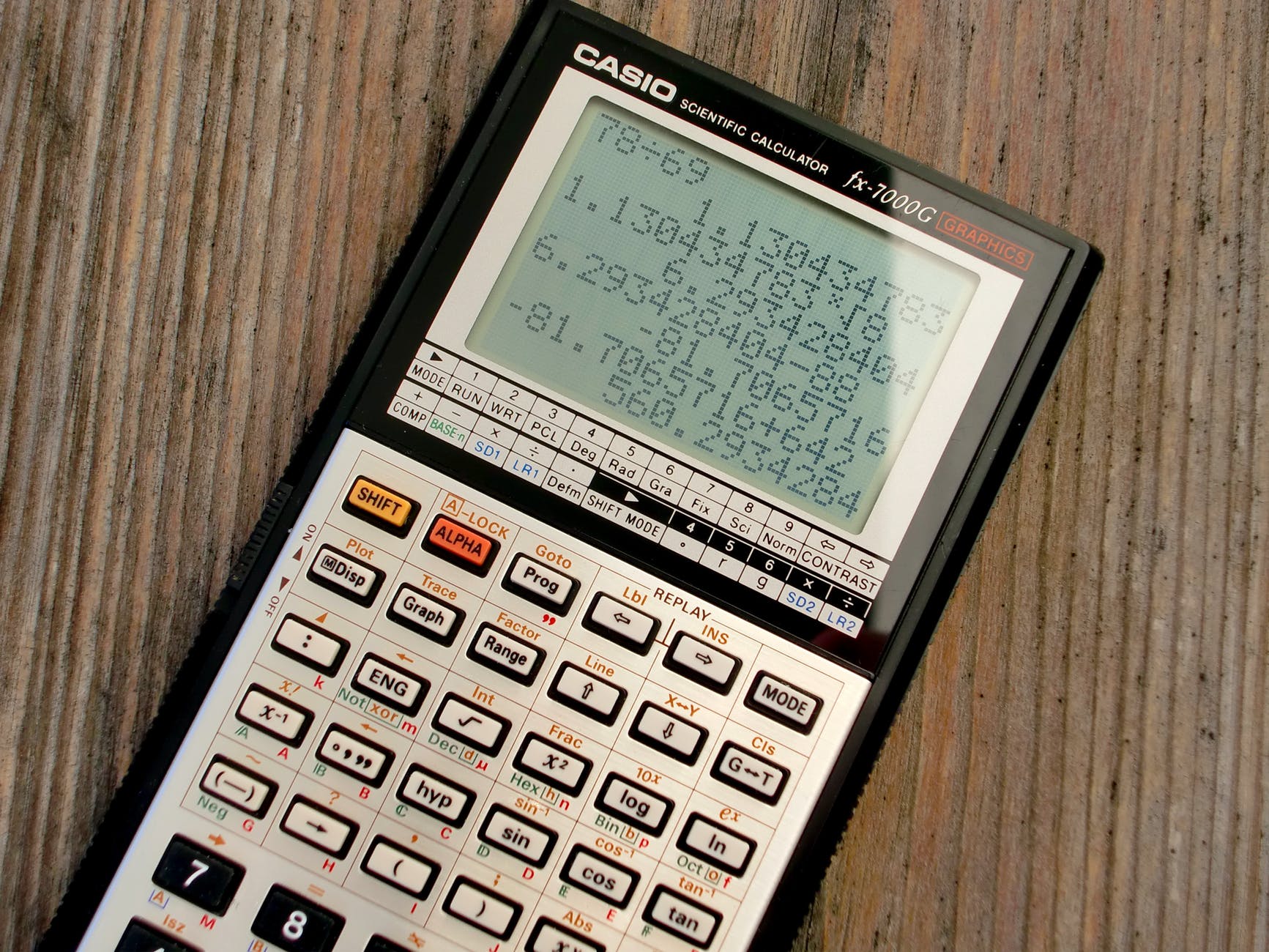
black and grey casio scientific calculator showing formula
Photo by Pixabay on Pexels.com

In all of my years of teaching mathematics the refrain that heard most often was, “I’m no good at math.” My job became to convince my students that anybody has the ability to learn the algorithms and fundamentals of math given a willingness to invest time and effort.

We all know someone who has a natural ability with all things mathematical. In my own case it wasn’t me. It was my brother. I had to go home from school each evening with my math book and my notes and work through problems until a light bulb lit up inside my brain. Sometimes that took just a few minutes and other times it took a couple of hours, but in the end I mastered one concept after another.

Most of my students have insisted that it is impossible to study for a math test. They are accustomed to memorizing facts for their liberal arts classes and they tell me that one will never know what problems will be on the quiz. Therefore they assume that working sample problems is fruitless, but I insist that it really helps. Just as doing reps in the various sports generally brings about improvement in muscle memory, so too does practicing mathematical ideas help imprint problem solving methods on the mind.

It took me several years before I understood the value of homework in math. I used to grudgingly do the problems as quickly as possible and I was unwilling to ask questions about things that I did not comprehend lest I be regarded as being not so bright. I was literally in college before I understood the value of asking my professors for help. I not only became more enlightened, but I also became known by them which was a big plus in my large university. I encourage anyone who is struggling with anything, particularly mathematics, to take full advantage of tutoring opportunities with teachers. It is one of the keys to mastering skills that may at first seem far too difficult.

I like to think that my own struggles with mathematics in my early years led me to being a better and more understanding teacher. I know how it feels to read a word problem and draw a complete blank. I recall tearful sessions with my mother after school when I would insist that I was never going to be good at solving problems. She taught me how to first work with the words, taking them apart enough to discover what I was being asked, and then applying the knowledge that I had learned. With pictures, highlighters and diagrams I now find that I am able to tackle any challenge, but it wasn’t so until I followed my mom’s advice.

I have a granddaughter who used to think of herself as being a bit slow on the uptake when it came to math. It bothered her that her brother never seems to have a problem to immediately understand even the most difficult concepts. She and I talked for a long while about my own struggles when I was her age, and she took my advice regarding the value of hard work in mastering her math lessons. Last year she was anxious about the end of course Algebra I exam that she would have to take. She spent hours studying definitions, processes and different types of problems. Whenever she came up with an incorrect answer she found out why and then worked dozens more until she was consistently getting the correct answers. In the end she received one of the highest scores in her class, but more importantly she learned that it is not only possible to study mathematics, but preferable indeed.

Confidence is usually the element that is missing whenever a student who is bright in every other way does poorly in math. At some point in time he/she has become convinced that it is useless to even try. Such students truly believe that they are missing some gene that would allow them to do better. They take tests feeling defeated before they have even lifted their pencils. It’s up to their parents and teachers to help them to find the good feelings that they need to do well with mathematics, and to show them how to work hard to get there. That means eschewing a temptation to tell the young ones that they come by their dread of mathematics naturally because difficulty with math runs in the family. There is little worse than instilling such fear.

We have to be certain not to create self fulfilling prophecies in our young. It is possible to master mathematics slowly but surely and often with a great deal of work. It is no different than practicing a butterfly stroke or learning a new techniques for drawing. It takes patience and determination in some cases, but it can be done. I have watched hundreds of my students become adept in a subject that had previously been terrifying for them. My job was not to trick them, but to show them the way.

The best mathematics teachers that I have known all rejoice when someone who has struggled finds the light. There is no better feeling. If I were able to accomplish one thing in my lifetime it would be to replace comments like “This is too hard. I can’t do it. I’ve always been terrible in math.” with ideas that speak to the value of practice, asking questions and being positive. One day I hope to hear more of “I don’t get it now, but I know I will. I know that anyone can do it.”   

My Horn of Plenty

abundance agriculture bananas batch
Photo by Pixabay on Pexels.com

I knew a man who had suffered greatly during the Great Depression. He and his family oftentimes went hungry and their mealtime staple was usually a pot of beans. When he finally made it into the middle class as an adult he refused to have beans at his table, not even red beans, although he was a bonafide Cajun.

My mother sometimes struggled to put food on the table, but she liked to brag that in spite of our meager budget we never once missed a meal. She was incredibly creative when it came to stretching the offerings in the pantry. She was such a good cook that we rarely noticed that we were sometimes nearing the end of our stores. Only once in a great while would the refrigerator be almost empty, and the cupboards be bare. Even then Mama used her ingenuity to whip up what felt like a feast. She told us that she had learned from her mother who fed a family of ten during the great depression. She told us the story of how our grandmother would cook a whole fish with head still attached. After everyone had taken their share Grandma would eat the head. Mama laughed and said the her mom was actually getting the part with the most vitamins.

I was a skinny girl who barely weighed eighty eight pounds on my wedding day. Food didn’t really matter that much to me. I rarely ate breakfast which was no doubt a bad thing, but I never really missed it. I took a sack lunch to school and it usually consisted of either a bologna sandwich on white bread or a fried egg sandwich. The egg was the more delicious of the two, but it embarrassed me to open the wax paper and let the aroma of cold egg waft across the cafeteria. Someone invariably made a comment, and I quietly did my best to disavow the idea that it was all that we had for that day.

It was supper time when my mother became like the Julia Childs of the low economic set. She was literally able to make hot dogs into a gourmet dish, often making up recipes to use the ingredients that she had on hand. After my Grandmother Little she was the best cook that I have ever known.

I suppose that I was much more affected by the scarcity of food in our home than I ever dreamed because I eventually developed a kind of fetish for fresh fruits and vegetables as well as lean cuts of meat. I like to have my larders well stocked at all times, and I get a bit nervous when they are not. I’m not much for purchasing junk food because that was never something that we kept around my childhood home. Instead I take great joy in visiting a farmer’s market or a really good produce department. I become like a kid in a candy store in such places. In fact, I actually enjoy going to such venues for fun. I suppose that if I am honest I must admit to carrying a hidden fear that the food will one day run out.

Nothing pulls at my heart strings more than seeing photos of starving children in distant lands. My mama used to caution us not to waste food, reminding us that children in some places would be more than happy to have the plenty that she put on our table. My brothers sometimes joked when she was not around that it wasn’t as though we could put our waste in a little box and send it somewhere that it would be appreciated. Of course, that was before we grew up and realized that even though we lived on the edge, we still had more than millions of souls whose misfortunes made ours seem like nothing.

I worked as a volunteer at the Houston Food Bank a number of times. Some of the students that I have taken with me ironically had used the services on a regular basis. It was humbling to realize that even within my own city there are families struggling to get the proper nourishment. I’ve often thought of my own mother and her incredible knowledge of ways to create a healthy diet on a very small income. We may have eaten beans and greens, but she understood the value that they gave to our diet, and cooked them so that they were also delicious. A problem that far too many people have, is a lack of understanding of how to feed themselves and their loved ones with only a small number of ingredients.

I have a good friend who is much like my mom. She uses every part of every kind of food that she purchases. She boils the tops of beets and the peelings from potatoes and all the rest of the seemingly unusable parts of vegetables to make broth that is filled with vitamins and flavor. She purchases big bags of overripe bananas that are practically being given away and freezes them for the smoothies that she makes her husband each morning. Whenever I’m looking for a good way to use food to its utmost she provides me with dozens of ideas. She even knows how to make her own chocolate and has devised a method for making ice cream that doesn’t even require a machine.

I used to shudder whenever I had cafeteria duty in the schools where I worked as I watched the garbage cans filling with perfectly good items that the children simply did not want to eat. I thought of those babies with bloated bellies and wondered if they would have been more than happy to munch on the food that would end up in a landfill. I found myself understanding what my mother had been thinking when she told me and my brothers not to take what we did not think we could eat. 

Food is one of our most basic needs. It is also a way to celebrate and gather with friends and family. We humans have turned eating into an art form. It is one of life’s great joys, and as I grow older it has also become a source of contentment for me to choose a juicy red tomato or find a display of perfectly formed apples. As I store away the meats, fruits, vegetables and grains I feel so thankful. Now when I make an egg sandwich for myself I see it as a great gift. The horn of plenty that is my refrigerator and pantry makes me feel quite thankful, particularly for having a mother who so quietly and courageously fed me an my brothers with no complaint and great joy. She taught me to have an appreciation for whatever I have and to never forget those who have so much less.