“Without Forgiveness There Is No Future”

Desmond-tutu

“If you want peace, you don’t talk to your friends. You talk to your enemies.”– Desmond Tutu

“Without forgiveness, there is no future.” – Desmond Tutu

During the summer months a nice breeze finds blows into my backyard along about dinner time,  so my husband and I usually enjoy our dinner outside each evening. We talk and enjoy the birds that find their way into the trees on our property and onto the fountain that they use as their personal birdbath. We hear the voices of neighbors who are bustling about on walks or doing a bit of work while the temperature is bearable. We linger at our seasonal dinner table until the sun is about to set and then we go back inside to end our evenings with reading or a television program before we retire for the night.

The big three channels are filled with silly summer offerings that are of little interest to us, a waste of our time. We search instead for more riveting fare and for that Netflix and Amazon Prime are difficult to beat. Recently we encountered a movie starring Forest Whitaker and Eric Bana called Forgiven that proved to be both entertaining and enlightening. It was set in South Africa in the days just after apartheid became illegal and Nelson Mandela had been elected President of the country.

In a spirit of unity Mandela had insisted that it was a time for reconciliation between all of the people so that they might all move forward together. He appointed Archbishop Desmond Tutu to head the Truth and Reconciliation Committee, a group tasked with examining crimes against humanity that had taken place in the past and determining how to deal with the both the victims and the perpetrators in a fair and compassionate way. Archbishop Tutu was a brilliant choice for this endeavor because he had worked tirelessly for social justice for most of his life, receiving the Nobel Peace Prize for his efforts.

The movie uses a fictional character played by Eric Bana to portray the racist and murderous nature of those who had previously inflicted murderous treatment on the native peoples of South Africa. The film creates a storyline to demonstrate the intent of the Truth and Reconciliation Committee in which Forest Whitaker as Desmond Tutu is frustrated by discoveries of mass graves and extreme violence. In the process Tutu becomes personally interested in the tragedy of one mother whose daughter simply disappeared on day never to be heard from again. He promises the woman that his commission will find the answers that she is seeking even while he struggles to fully understand what happened.

Archbishop Tutu receives a letter from a prisoner, the Bana character, seeking amnesty for his crimes. The convicted murderer is vile and violent, unrepentant for the horrific things he has done, virtually challenging Tutu to maintain his composure and his belief in the ultimate goodness of all people. The movie is a thoughtful and well acted commentary on mankind itself.

As I watched the plot unfold I found myself contemplating the differing schools of thought regarding how to deal with violence, racism, and other evils in the world. Some like Archbishop Tutu and Nelson Mandela chose models of kindness and reconciliation as a tool to bring people together. Others in history have eschewed such behaviors for aggressive militancy. Today we appear to be in a time in which passive resistance is out of fashion, and instead an unwillingness to even consider alternate points of view is the more popular problem solving methodology. Those who find ways to expose flaws and judge without understanding are winning the day and I find the trend to be difficult to stomach. My personal heroes are people like Mother Teresa, Dr. Martin Luther King, Jr., and Archbishop Tutu.

In my own country I find it difficult to watch the ways in which we are tearing one another apart. The trend has been simmering for some time and now it is in full blown mode. I was certain that President Donald Trump would be rejected for his bullish ways, but instead he has been viewed by many as a kind of hero for his brash insults. Now we have some candidates for the Democratic nomination for President vying to bring down even those who mostly share the same points of view as they do.

Frankly I was quite embarrassed when Kamala Harris chose to publicly chastise Joe Biden for his past even as she insisted that she did not really think he is a racist. If that is true then I wonder why she felt it necessary to even bring up the matter. I was stupefied when the very person who began the “food fight” of the debate condemned what she saw as the childish behaviors of the other candidates. Even more confusing to me is the fact that her popularity has suddenly increased as many see her antics as a breath of fresh air rather than the bullying that it is. 

I am quite saddened by today’s political environment. It seems to be propelling us backward in time rather than pushing us forward. I do not believe that it will bring us to solutions to our problems nor will it heal the divisions that are growing like an ugly crack in the windshield of a car. We desperately need a peacemaker to step forward to lead our country back into a place of forgiveness. As Archbishop Tutu so brilliantly contends without it there is no future. 

I Am the Median

road sky clouds cloudy
Photo by Gratisography on Pexels.com

From a statistical point of view my life has hovered around the median. I represent continuity and moderation and a mix of conservative and progressive points of view. While my life was tragically made a bit unusual for the times in which I lived by my father’s early death, that anomaly was mediated by the environment in which I grew into an adult. I am a product of a small and insular neighborhood in a time when my native city of Houston was still more of a town than a city. My life was guided by routines and traditions that rarely varied. There was an entire village of people both familial and unrelated by blood who watched over me. I grew strong and happy and so loved that I was ready to tackle any challenges that came my way. As an adult I was so busy attempting to reconstruct my own sweet world for my children that I barely noticed how much the times were actually changing.

When I was seven years old I was uprooted from everything and everyone that I had ever known to accompany my family on a journey west where a quiet revolution of opportunity and change was overtaking people like a fever. My days there were painful because I had lost the anchor of extended family and friends that always made me feel so secure. I was among people who were so busy building dreams that they had little time to welcome us. I went to school each day feeling nameless and misunderstood. Ironically my father felt the same way at his work. None of us ever fit in to the race for something unknown that so dominated life in the part of California that would one day be the epicenter of Silicon Valley. Before long we all just wanted to be back home in Texas.

With little more than a wing and a prayer we slowly made our way back to what we had known. Along the way my father searched for a job. His efforts to find work lead us all the way back to Houston, and for the very first time in a long time I recall feeling quite relieved even though we had not yet settled into a permanent home. My father’s deadly car accident left my mother bereft and scrambling to create a sense of continuity for all of us. Luckily we had returned to the people for whom we had longed when we were far away and they gathered in unison to help us every step of the way. Oh, how I loved them and still do!

My mother wisely returned us to the very neighborhood from whence we had moved only months before. We were welcomed like the Prodigal Son. Our life began its constant revolution around church, school, family and friendships. There was a lovely sense of calm about the way we lived. We stayed in the same house until all of us were grown and on our own. We had the same neighbors for years. It was rare for anyone to move away back then. When we went to church each Sunday we saw the familiar faces of people who smiled and greeted us by name. We attended the same school with the same kids who are friends with us even fifty years later. Each Friday evening we visited my maternal grandmother in a gathering that included all of my aunts and uncles and cousins. In the summer we traveled to visit with my paternal grandparents on their farm.

We constantly heard stories from our elders about the history of who we were that carried little nuggets of expectation without being overbearing. At church we learned about the comfort that is always available from God and the ways of compassion and love that Jesus taught the world. Our teachers and our parents spoke openly to us about both the greatness and the imperfections of our country, urging us to always remember our responsibility to maintain a healthy democracy.

We were always a bit behind the fads and movements along the two coasts of the country. We were more inclined to study how things went there before jumping into the idea of adopting radical change without much thought. Our lives were slow and steady like the tortoise. We knew that we would eventually get to our desired destinations, but we did not want to lose sight of more important things like family and friends along the way.

Suddenly it seemed as though both the innovations and the cautions that were brewing along the two poles of our nation roared up around us, forcing us to see the world through different eyes. The titans of media and advertisement from the east coast were burrowing into our brains with television. The movie moguls influenced us with films. Finally the masters of Silicon Valley invaded our lives with computers and smart phones and a burgeoning social media. People began moving around and moving up. Extended families had less and less time for each other and friends were often on the go. We woke up one morning and the city of Houston had become the fourth largest metropolitan area in the country.

Some of what happened while we were sleeping was very good. There were breakthroughs in civil rights that were imperfect, but steps in the direction of equality. Women were provided more opportunities than ever and their voices began to be heard. We acknowledged that love is love regardless of whether the people who express it for one another are man and woman or man and man, woman and woman. Medicine and science made our lives easier and our affluence grew.

At the same time we have lost many things as well. Our neighborhoods flux and flow to the point that the relationships that we form there are constantly changing as people move from one place to another. Our extended families are in far flung places and gathering our relations together becomes more and more complex. Our churches and our beliefs are continually challenged. We fear for our children to play outside alone. We argue and rankle with one another and wonder if how far we change is enough or too much. We feel as though we are being ruled by extremes, either far too cautious or far too willing to upend all that we have known. We have lost our sense of history and our willingness to accept that none of us, not even ourselves, are free from the taint of bad decisions or hurtful behaviors. We judge and decry those who do not share our own philosophies. We honor those who boast and demean while turning our backs on the people who live with quiet dignity and respect. It feels as though we are somehow being manipulated by some unseen hand as though we are merely robots. None of it feels good, and some of us long for the good old days not because we are unaware of the problems that some people faced while we were comfortable, but because we need to bring the village of diverse people who loved us back together once more. We need to feel that sense of chest bursting pride in our families and friendships and churches and cities and states and our country that might have once brought us to a sense of belonging to something special.

We have many folks attempting to understand our thinking and our motivations and I suspect that they are getting us all wrong. They tend to make assumptions about us based on their own backgrounds rather than ours. Suddenly I find myself feeling untethered much as I did when I was seven years old in an environment so different from what I had always known. I understand how it must have been to be my father daring to dream, but realizing that he did not quite fit into a way of life so unlike his own. I am the median, an average person with a big heart and a dream of embracing the people to both the right and the left of me in a hug that says,  “You might want to know how folks like me really feel rather than foisting your ideas on everyone. Your constituency reaches from sea to shining sea and there is a great deal in the middle that you are yet to understand. Maybe it’s time for you to learn.”

The White Rose of York

The Shambles

York is about a four hour drive north of London by car or two hours by train. It has a history as long and important as London, and was home to three kings. The House of York was a branch of the Plantagenets, represented by a white rose. The dynasty was troubled by war and ended with the death of Richard III and the rise of the Tudors. It was once a bustling city of great power lined with shops and industry. The Romans had a settlement there, and much of the wall that they built still stands. It is a unique place well worth the effort in getting there.

We set out for York on a Tuesday morning and arrived by early afternoon. Brother Pat was so adept at driving on the highways by then that we were rather carefree on the journey, spending most of our time enjoying the the landscape which became more and more magnificent the farther north we traveled.

We had rented a flat for the night in York that housed all six of us. It boasted a full kitchen, three large bedrooms, two baths and a living area all for less than two hundred pounds a day. It was clean and modern and within walking distance of all of the major attractions. We all agreed that we had done well in finding it even though we were generally unfamiliar with the area, relying only on photos to give us an idea of what we were getting.

Since we had tickets to visit York Minster, a magnificent medieval church, the following day we headed to the old town area known as the Shambles. Some say that it’s ancient cobbled streets lined with quaint shops were the inspiration for Diagon Alley in the Harry Potter stories. The hooks where butchers once hung their meat still hand over the walkways, and the tiny stores are filled with all sorts of interesting delights.

At the edge of the old town area was an open market place where vendors sold baked goods, antiques, jewelry, crafts, and even fresh meat. I came upon some Willow Ware dishes that included teacups, plates, a pitcher and a bowl. They were exactly like the traditional ones that I collect save for a different hue of blue. I was quite taken by them and knew that I had to purchase them when the seller offered the entire set to me for only twenty two pounds. It was a real bargain.

As she bubble wrapped each dish for me we spoke of York and the things to do there. Then she mentioned that if we had time we should definitely take a short side trip to a place called Robin Hood’s Bay that was just east of the area on the North Sea. She explained that she always took visitors there because it is a unique and beautiful place. By the time I was ready to leave with my purchases she had convinced me that we needed to find a way to include the town as one of our destinations.

We spent the rest of the afternoon visiting Christmas stores, sampling fudge, sipping on tea, eating ice cream, and laughing in magic shops. I purchased several art prints of both York Minster and the Shambles to go with the pictures from other cities that I have gathered over the years. I felt as though I really was in another world in another place and time until we eventually found our way back onto modern streets.

We decided to cook some spaghetti for dinner, so we purchased some fresh ground beef, known as crumbly beef in England, from the open market meat vendor, some fresh loaves of bread from a little bakery, and the rest of our food from a tiny grocery store. We walked back to our flat enjoying the beautiful weather and the flowers that seemed to be blooming everywhere.

It was a very pleasant stroll even with our heavy parcels. By then we had grown accustomed to walking  several miles each day, and the views in York were particularly enchanting. I saw trees, bushes and flowers unlike any that I have ever known and we all stopped often to snap images of the loveliness that was so bountiful.

We spent the evening enjoying a great meal made by my brother Pat. His skills in firefighting and driving are only outdone by his abilities as a chef. We ate his home cooked meal with gusto and then we played games and laughed and joked until late into the night. It is amazing how relaxed we had become and how much we had adapted to a slower way of life. It felt as though we had landed in a happy little bubble where there were no problems, and no bad feelings. Everything and everyone seemed as quaint as the programs on PBS that feature little villages where folks are friendly and life unfolds at a slower pace.

Of course we understood that real England is no doubt different from vacation England. We had set aside all of our worries and cares for a time, but indeed they must exist for those who live there. Still, it was nice to be free from any sort of concerns and to just live fully and happily in the  moment. Best of all was the opportunity to spend so much time with my brothers and sister-in-laws. There is something quite magical about sharing a trip with people that I love. The memories will now and forever bring a smile to my face.

We retired that evening feeling quite content but also excited about visiting the magnificent church that so dominates York. We were also more than curious about what we might find if we actually decided to travel to Robin Hood’s Bay.

Victoria and Albert

Victoria and Albert

Until the reign of the present day queen, Victoria had held her office longer than any other monarch in the history of Britain. Her influence on Europe and the world was enormous and the story of her relationship with Albert became the stuff of fairytales. She was the transitional figure between the nineteenth and twentieth centuries, seeing and bringing changes to the country that brought the nation into the modern world. Her children and grandchildren had a profound effect on history in two major wars and their impact continues into the present day. We all seem to have a kind of fascination with Queen Victoria, and in particular her consort, Prince Albert.

Victoria and Albert were first cousins who fell in love, married and together had nine children. Albert’s influence on Victoria was enormous and while she clung tenaciously to her own independence as a monarch she supported many of his ideas for modernizing the country that she ruled. He was a somewhat forward thinking man with varied interests that kept him continually engaged. After his death Victoria went into a state of depression and mourning, never again wearing anything but her widow’s weeds. 

After watching the changing of the guard at Buckingham Palace our group traveled by Tube to the Knightsbridge area of London where the Victoria and Albert Museum is located. The station exit revealed a lovely neighborhood filled with trees and refined looking buildings. Only a few steps away was the museum that we were seeking. It is an imposing structure that opened up into a decidedly open and airy hall once we were inside. It showcases a cornucopia of art, sculpture, textiles, furnishings, ceramics and decorative pieces. Founded in 1852, the museum was named for the queen and her husband. It houses a permanent collection of more than two million objects, and best of all there is no charge to see most of the works of art.

After first stopping for a brief respite and a small snack we wandered from one section of the building to another delighting in the glorious sampling of art that was on display. I was particularly taken by one hall that featured works by Rodin and other sculptors. We enjoyed watching a young woman creating a pencil drawing of one of the sculptures. She told us that she had been working on it everyday for weeks and she was in hopes of completing in on that day. She mentioned that many artists find inspiration at the Victoria and Albert, and I too felt that there was a lively spirit to the place that made it something more than just a repository for old things.

I was particularly taken by an entire hall that featured the craftsmanship of Islamic artists. The rugs, textiles, vases, bowls, and woodcarvings were so delicate and uniquely colorful. They seemed almost to have been crafted by heavenly personages rather than humans. There was a lightness about them that was otherworldly. I was transfixed by the beauty and found a kind of serenity in simply gazing at the various objects.

Another room was set up to show the clothing and furnishings of various eras. It was so interesting to the trends and the fashions of each historical period. I found myself marveling at how small the sizes were compared to what we use today. We humans have certainly grown larger over time thanks to the abundance and variety of food that is now available to us. The everyday diets that we take for granted were once the domain of only the wealthiest, and even they did not enjoy the miracles of interstate commerce that bring us delights from all over the world.

As someone who has always loved fashion I delighted in a room that featured women’s clothing from different eras and decades. I am old enough to have remembered the lovely fitted dresses and suits that the women wore in the nineteen fifties and the mini-skirts and mod styles that I donned in my college days at the end of the nineteen sixties. The styles that were featured were so lovely and amazingly so classic that if someone were to wear them today they would no doubt look quite fashion forward.

The museum complex features a large splash pool where youngsters played excitedly while their parents watched with unadulterated joy. I smiled at the relaxed and lively spirit of the place where every person seemed to have a contented smile permanently affixed to his/her countenance. I imagined that Prince Albert in particular would have been quite proud that even us common folk were able to view so many treasures. I felt so welcome and so relaxed there and might have stayed far longer but for the fact that we had a reservation for Skye Garden and needed to depart.

I spent my last moments in the gift shop which was the most wonderful of all such places in London. I purchased two tea towels crafted from extraordinary patterns. I plan to use them whenever I have a tea time with my grandchildren or my niece. I also chose an apron that was so lovely that I can’t imagine actually using it while cooking. Nonetheless it will be nice to don at the last minute for the Sunday dinners and special occasion extravaganzas that I so love to provide to family and friends.

In a single day I had mulled over the long history of England and the role of royalty in the modern world. Somehow the Victoria and Albert Museum had helped me to understand the symbolic significance of the monarchy. I suspected Victoria and Albert’s influence in making more recent kings and queens more caring about the people. I felt more and more kinship with the idea of having a royal presence and I somehow began to realize what the Queen represents. 

The Yanks Come Home

The Yanks Come Home

Each of us is unique and yet through a combination of nature and nurture we also share common traits and histories from our ancestors and our relationships. Our characteristics and our personalities come together to make us who we are and how we react in the world around us. I am a mixture of European DNA and a lifetime of experiences in the United States of America. I have always been curious about the long strand of genes and stories that brought me to my personal place and time. I have been surrounded by books and tales and inherited traits for all of my life, and I have sought answers to questions that swirl in my mind.

In a sense I have been slowly moving in search of the source of so much of who I am from the time that I listened to my father reading fairytales to me and the days when my English teacher, Father Shane, enthralled me with literature and poetry from the greatest authors of Britain. I am a “Yank” who desperately needed to see the place from whence I came, and so I embarked on a journey meant to enlighten me and answer the questions for which I longed to find answers.

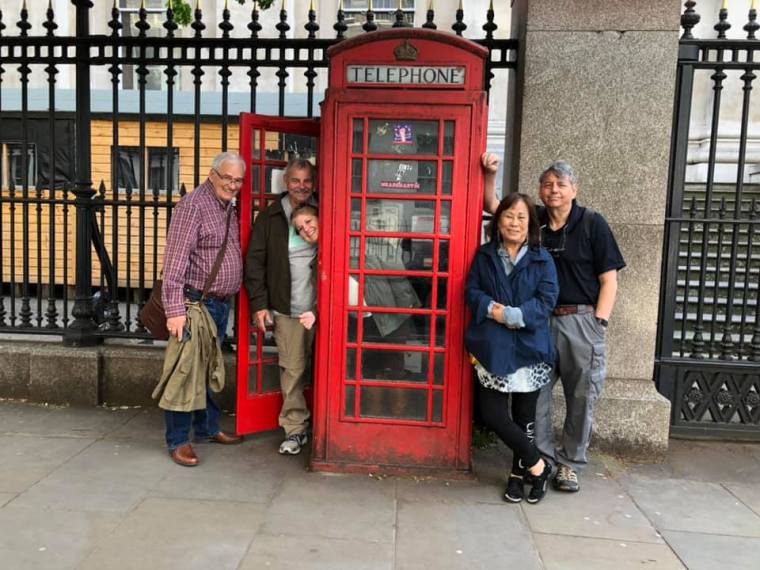
Thus I planned a trip to England with my husband, and my siblings and their wives that was to commence in the middle of May and end on the anniversary of my father’s death which seemed a fitting tribute to him and the people who had made him. It would prove to be more than a casual adventure, and instead provide me with the a kind of spiritual appreciation of the intricate dreams and journeys of the people who came before me. I have witnessed my own humanity in the eyes of strangers in a foreign land who nonetheless seemed so much like me.

Our trip began with the irritations and vagaries of rainy weather that left my brother and his wife stranded in Houston and threatened to prevent the rest of our party from making a connection in Dallas. Luckily we had a determined pilot who got us where we needed to be just in the nick of time. Our economy seats were hopelessly uncomfortable and so we spent the night fully awake and thinking that perhaps we might never again want to board a plane to fly home unless we upgraded our accommodations.

I had to admit that one night of torture in cramped conditions was nothing to fuss about when compared with the dangers and discomfort that our long ago ancestors must have endured as they traveled on ships to a world of unknowns. I wondered what hardships had driven them to leave kith and kin behind, and thought of how awed they would be to see me watching movies while a bird like machine flew me across the Atlantic in only a few hours. Somehow my complaints seemed overblown when viewed through the lens of their realities.

It was around noon London time when we arrived. Thanks to the help of Gerald Warren, a friend and work colleague who travels frequently to that glorious city, we knew exactly how to navigate from the airport to our hotel in Bloomsbury. We took the Heathrow Express to Paddington Station and then secured a taxi for a ride to the Holiday Inn where we would stay for the next fifteen days.

Since it was a Sunday we quickly left our rooms in search of the traditional English Sunday roast, and found a nice pub just across the street that was serving the food we sought in a warm environment filled with locals who chattered happily with one another. My husband Mike had grown up eating his grandmother’s roast and Yorkshire pudding. She had immigrated to Texas from Newcastle just before World War I when she was only eight years old. While she grew to love her new country she often recalled hearing the strains of “Auld Lang Syne” when her ship departed and she could never again enjoy that tune without feeling a bit of wistfulness. All that she had known seemed to have been left at that dock, but she never forgot the traditions of her native land which included having afternoon tea and preparing Yorkshire pudding with roast beef on Sundays.

The roast, potatoes and carrots at the pub were quite good, but the Yorkshire pudding was rather disappointing. Mike had eaten the muffin like delicacy that his grandmother made and he was searching for some that might come close to hers. Ours was not even close to his granny’s. Nonetheless we felt quite satisfied and ended our first day in London with a leisurely walk around the neighborhood. We were tired from staying awake all night and eager to begin our tour in earnest on the following day, so we went to the Russel Square underground station that was just around the corner from our hotel and purchased Oyster cards to cover the cost of rides on the Tube in the coming days.

I was already enchanted by what little I had already seen of London and I felt somewhat like a young and eager child as I tried to quell my anticipation of the wonders that lay ahead. Thanks to the common language, the friendliness of the people,  and the advice from Gerald and others who had already visited England I felt certain that we were in for a glorious time. My brother Pat and his wife Allison were finally on their way to meet up with us, and I had rain gear at the ready for London’s notoriously wet weather. I was ready and so I fell soundly asleep feeling as though in some spiritual way I was back home visiting relatives. I felt that we Yanks had finally come home.