A Walking Timeline Through History

Trafalgar Square

When the best laid plans go awry, pathways to new adventures often show themselves. We were to have spent our morning watching the changing of the guards and our afternoon at Westminster Abbey. The cancellation of the tradition of pomp and circumstance at the palace had sent us scurrying to the Gothic church far earlier than intended, so once we were finished with our tour we became untethered and aimless wanderers around London.

The roads almost inevitably lead us past the halls of Parliament where protests centering on the Brexit issue were a constant feature during our time in the capitol city. We glanced disappointedly at Big Ben which was shrouded by the apparatus of reconstruction save for the face which never changed because it was not working. We wondered as we longed to hear the famous chimes if somehow all of our planning was doomed to go up in flames, but we soldiered on, walking past a highly secured area that housed the home of the outgoing Prime Minister.

There was much stirring behind the gates. We saw official looking men wearing formal  jackets filled with medals leaving the premises with grim expressions. It told us that Theresa May was no closer to creating a plan for transitioning Britain from the European Union to a  more nationalist entity. There was a noticeable tension in the air that hovered over the halls of government and the silence of Big Ben added a metaphorical touch to the chaos.

After walking for what had seemed like many miles Trafalgar Square was in view and husband Mike became quite animated by the thought of seeing the iconic tribute to those who had fought so valiantly in World War I. First, however we would pause for lunch in a nearby pub where I admittedly struggled to find something that appealed to me on the menu. I generally eat a very light midday meal and there was very little of that sort to be found among the traditional English food being offered, so I essentially skipped eating and instead enjoyed a lemonade and a much needed rest for my feet. I used the time to find and purchase the tickets that we would use later that night to see the choral concert at Westminster Abbey.

Once everyone was refueled we headed to Trafalgar Square which was quite joyfully bursting with life, mostly from tourists and street artists. The atmosphere reminded me of the area around St. Louis Cathedral in New Orleans, Louisiana. There were accomplished musicians and singers entertaining the crowd with performances worthy of Albert Hall. Using only chalk and their imaginations many individuals drew masterpieces on the grand sidewalks of the square. A gigantic fountain surrounded by enormous lion sculptures served as a photo opportunity for everyone who passed by, and of course there was the famous obleisk honoring the courage of those who defended the nation in World War I.

This was indeed a happy area where the tension surrounding the government buildings was replaced with a kind of serendipitous celebration of art and humanity. It felt good to be there and somehow made up for the botched intentions of our morning. We all realized that while we had not achieved what we had planned, we had stumbled upon something that was nonetheless glorious.

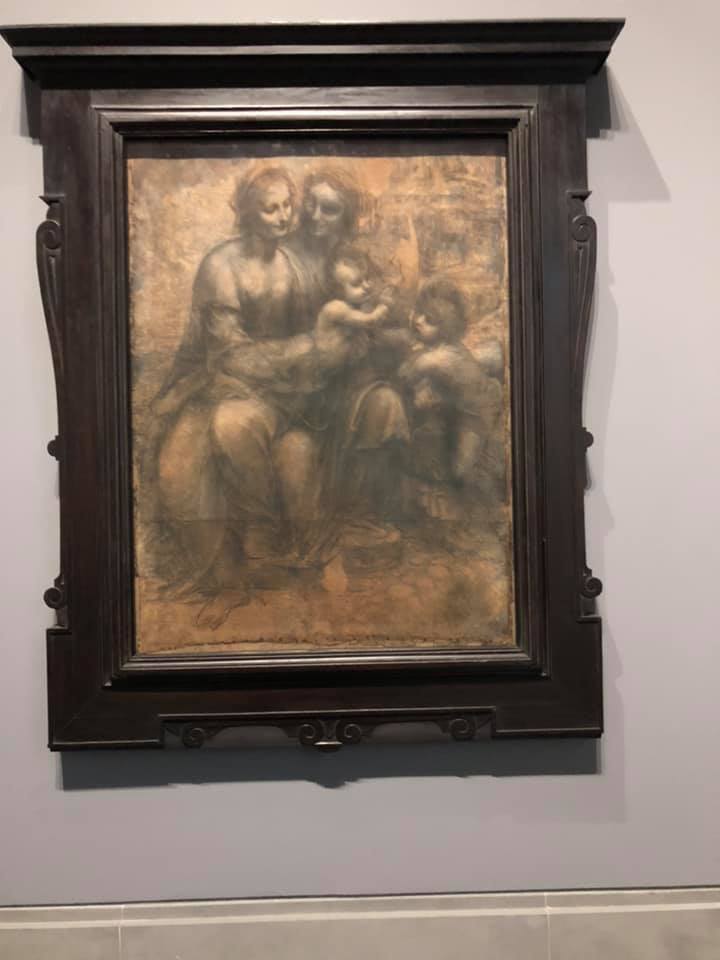
Just beyond all of the revelry lay the National Gallery which like so many sights in London was open to the public at no cost, so we decided to partake of its vast collection of paintings and sculpture in the time remaining before our evening engagement. This would prove to be a wonderful decision because some the the most famous artists the world has ever known were featured in the multi-story galleries.

I enjoyed so many of my favorite painters and was filled with appreciation for some about whom I had known nothing. Without a doubt, however, the experience of wandering without warning into a room containing the work of Leonardo da Vinci was the highlight of the visit for me. The funny thing is that I had spied his drawings from out of the corner of my eye and had noted that I felt drawn to to them before I realized that the great master had created them. There was a kind of lively charisma to even the preliminary sketches that elevated the pieces to a level unmatched by any of the other artists.

I might have stood transfixed in that room for hours were it not for the fact that we had agreed upon a meeting time in the coffee shop, and that hour was drawing near. It was with great reluctance that I took one final glance at the glorious paintings and headed down to meet with the rest of our party.

We enjoyed a bit of respite and a great deal of animated conversation over steaming cups of Earl Grey tea as we spoke of our favorite works of art. We all agreed that we had somehow been led to a most enjoyable afternoon by the “gods of travel” and we promised that if we had some additional time later in our trip we would gladly return to this wondrous place to be certain that we had not missed anything.

When we emerged into the late afternoon air we saw that the festivities taking place in Trafalgar Square had not abated. It seemed to be an oasis of cheer and goodwill which was perhaps the intent when it had been designated as a memorial to all that is good about Britain. After the horrors of World War I the citizens needed to remember, appreciate, and celebrate the many sacrifices made. I thought it fitting that the joy of peace time was still very much in the air.

We walked away with an even greater sense of the spirit of London and its people. In a single day we had looked far back into their history and gazed at the gravity of their present. It had been like walking a human timeline during which we witnessed the resilience of the people. We realized that they had made mistakes before, and perhaps were enduring them even now, but always they seemed capable of adjusting their course and moving on the right side of history.
The Voices of History

Westminster Abbey

At least half of my roots go far back into the history of the United States of America. I have ancestors who fought in the Revolutionary War. My kinfolk were hard scrabble people who emphasized the dignity of work done well and often spoke of their pride in being Americans. While my mother greatly admired Queen Elizabeth she admitted that America had allowed her to feel equal in every way to royalty. She once spoke of wanting to meet the queen but insisted that she would not be inclined to bow and curtsy to her. She enjoyed the freedoms of being American that her father had taught her to embrace. He had told his children that being citizens of the United States meant that they might openly celebrate the fact that they were as good and worthy as any other person on the earth. Mama certainly passed on such thinking to me and my brothers as well, so it was with a slight bit of haughtiness that I set out on a sunny Tuesday morning to view Buckingham Palace and the changing of the guard.

The early hour ride on the Tube was quick and easy. There were only a few stops and no line changes so the members of my group and I chattered with excitement over the prospect of seeing a bit of British tradition come alive. A short walk through Green Part lead us directly to our destination and even from afar we saw the Queen’s flag flying to indicate that she was indeed at home on that day. We joked about hoping to catch a glance of her moving through the rooms knowing that it was unlikely to happen.

As we approached the London headquarters of her Majesty we marveled that we were going to get a ringside view of the proceedings because there were few people who had come three hours before the event. Our bubble of excitement was quickly burst when we observed that the red coated palace guards were not there, but instead had been replaced by an unfamiliar regiment wearing simple helmets and all black uniforms. Furthermore a small white notice posted on the fence announced that there would be no ceremonies on that day, so we just took a few photos and tried to hide our disappointment in seeing our carefully planned schedule changed so suddenly. We joked that we were at the very least able to get great images of the building itself and we waved back and forth at my sister-in-law Allison who was wearing a shirt emblazoned with the title “Queen.”

In the spirit of keeping calm and carrying on we headed over to Westminster Abbey, a fairly easy walk from the palace. There was already quite a queue when we arrived but we had purchased tickets for the day in advance so we at least were in a shorter line than those who were buying admission on the fly. It was not long before we were inside that historic church and gazing at history.

The tour was self guided which turned out to be perfect for me. It allowed me to move at my own pace and experience unfettered emotions. The sheer scale of historical events and people associated with the place was overwhelming. I literally felt the spirit of the giants who had been there and were buried there, as well as the voices of the unnamed people who had worshiped in that sprawling area. It seemed that every inch of the place was filled with stories of humanity. I had studied the history of the kings and queens, read the works of the poets and writers, marveled at the contributions of the scientists and mathematicians. I walked humbly in their footsteps, honoring their memories as I read the plaques and actually saw images about which I had only before read.

I literally found myself feeling moved to tears more than once, so I was glad that I was alone. I was able to embrace my thoughts and my sense of connection with the sweeping history and importance of Westminster. I saw not just the glory of the very influential people who were buried there, but also the magnificence of the tradesmen who had built a structure that would live and breathe with life long after they were gone. I thought of my own grandfather Little and the pride that he had felt in being a builder of buildings. The mark of so many souls was present in every stone and every corner.

We had planned to attend Evensong at Westminster that evening but that too had been cancelled to allow for a concert instead. It was a great disappointment to husband Mike who had so looked forward to hearing the traditional evening service in honor of his grandmother who had kept the faith that she had learning in England when she came to Texas. He had hoped to get an idea of what his grandmother knew and loved, but even that plan was not to be.

I learned long ago that life is full of twists and turns that surprise us. I’ve had to be flexible for most of my life. I don’t always get what I want when I want it, but I know how to make the best of things. When we stopped for lunch after spending many hours exploring Westminster I took advantage of my smartphone and found that there were exactly six tickets remaining for the concert of that evening. After taking a quick poll of who wanted to attend the event I purchased them and suddenly we were set for a most remarkable and unexpected treat.

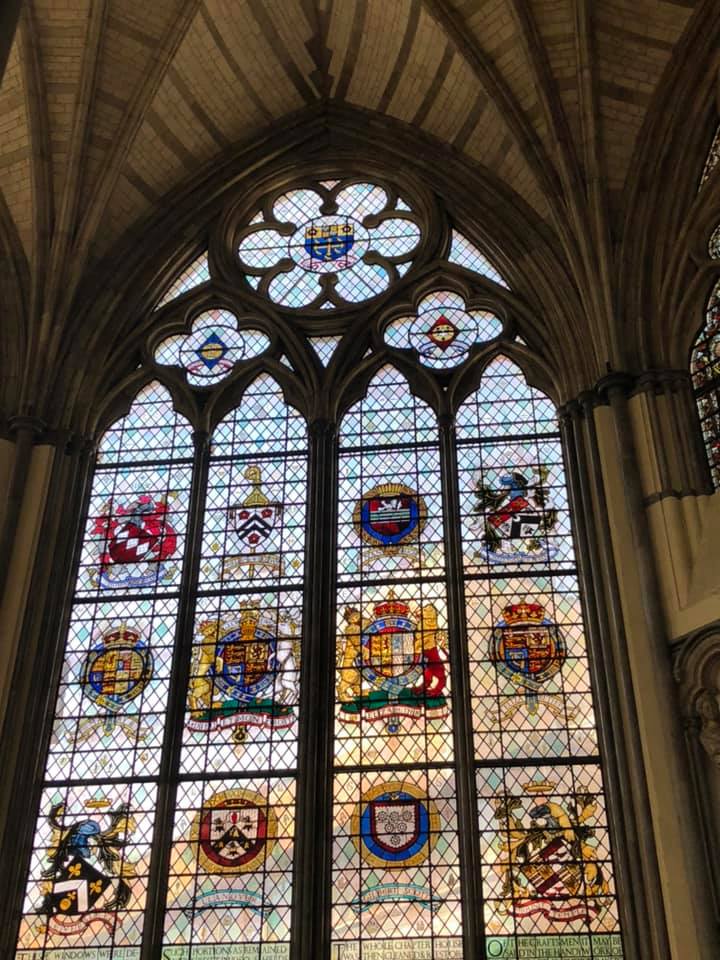
When we returned to Westminster later that day we were entertained with a choral extravaganza that included music from Handel that had been written for the coronation of George II in that very church. With the first strains of the music I found my eyes filling with tears of emotion. I heard the voices of the all male choir soaring to the top of the high ceiling just as it might have once done on a very important occasion of long ago. I gazed at the stained glass windows and the gigantic pillars with a more understanding set of eyes. I knew that the serendipity of our changed plans was better than a simple Evensong might have been and I was quite happy for Mike because I saw in his face that he was feeling the same as I was.

During a brief intermission I had time to speak to a lovely woman who was sitting beside me. By happenstance she had worked for a financial company whose headquarters are in Houston. She inquired about the floods that we experienced from hurricane Harvey and spoke of a fundraising drive that Londoners had held for my city. We talked as if we were old friends and in some ways perhaps we were. The sense of human connection that I felt in Westminster became even stronger and somehow I knew as strains of Bach’s Magnificat rounded out the concert that life always has a way of turning out just as it was meant to be. I heard not just the voices of the choir but also those of all who come before me, and it filled me with great joy.

Wonders of the World

British MuseumThe Bloomsbury area of London is the home of the university of London, Kings Cross Station, and the British Museum. A short stroll in almost any direction leads to lovely sights. In May the gardens and window boxes are filled with lovely flowers of every hue. Tiny markets offer fresh fruit and sweet bouquets. It’s a pedestrian world in which the sidewalks are filled with walkers strolling more leisurely than in the heart of the city. It is a place where lingering just a bit longer is in fashion.
On the first full day of our trip we chose to eschew hurry, and instead enjoyed a scrumptious English breakfast buffet in our hotel. We feasted on fried, scrambled and poached eggs with little English sausages, baked tomatoes and sautéed mushrooms. We enjoyed steaming pots of Earl Gray tea or tasted the brew from the latte machine. Crusty loaves of bread beckoned us and a bounty of pastries were ours for the taking. We had our choice of cereal and fresh fruit, cheese and pancakes. It was a good way to start our adventures for we would walk ten of thousands of steps, many miles in a single day.

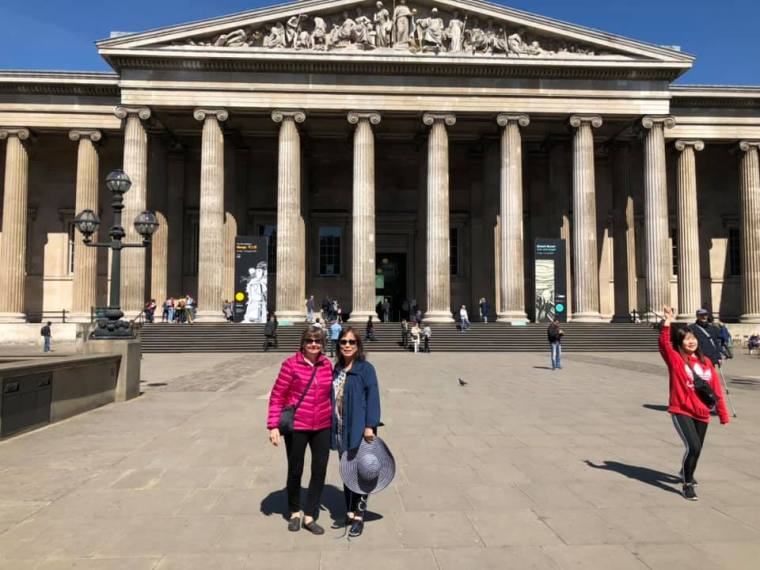
Our quest was to visit the British Museum about which we had long heard. The building in which great treasures are housed is an imposing structure which would be worth a look even without ever going inside. Once we had entered we were in awe of the great halls and sensed that we were about to see magical things that we had only before read about in books. After gathering and studying a map we decided to go first to the Egyptian section where we were immediately taken aback by the presence of the Rosetta Stone, an imposing treasure that would have been worth the trip all by itself. 

From that first moment we were in awe of the treasures that were displayed for what seemed like miles. It was difficult to know where to first look or what direction to follow. The trove of artifacts was so expansive that it gave me the feeling of being an adventurous archeologist who had suddenly stumbled upon a great find. I felt humbled as I gazed at items so exquisite and so old that I had difficulty processing an image of the creative and skilled people who had made such things in a time when tools were simple and scarce. I found my mind going far back into the history of mankind, and I marveled at the human connections that I felt with the people who had left such incredible marks on the world. I also thought of those who were simply nameless persons attempting to deal with the challenges of living, often under great duress.

I was brought back to present day reality only when I saw a group of young school boys careful taking notes about what they were seeing. They were so cute in their jackets with crests on the breast pockets and their earnestness in deciphering the mysteries of the many artifacts that they passed. I suppose that I will always love children and feel proud of the tiny contribution that I have made in the long range history of a generation. I think that we humans create because we have always desired to find some kind of purpose to our existence,

I was so caught up in seeing Roman statues, Greek urns, and Chinese porcelain that I hardly noticed that six hours had passed and it was time to enjoy a traditional afternoon tea gathering. Our group ate little sandwiches filled with chicken, salmon and eggs. There were scones and cakes and tiny cookies. We relaxed and chatted about what we had seen and how we felt. We worried just a bit about how so many things had been brought to Britain from the places where they were found. We wondered if they had simply been confiscated or if there had been permission, agreements, and payments for taking such things. I suppose that there are many different points of view as to the ethics of having such museums, particularly when the items include actual mummies. Is it wrong to raid a sacred tomb, or should we honor the purpose of such rituals by leaving them intact?

After refueling ourselves and debating the pros and cons of how and whether or not we were somehow complicit in the rightness or wrongness of such a museum we continued our study of the many different rooms. We saw Mayan carvings, and intricate woodworking from Abysinnia. We walked past glorious creations from India and Japan. Our heads were swirling from trying to read the descriptions of what we saw and achieve some kind of understanding of the magnitude of the glories of each culture represented in space after space.

Soon it was nearing five in the afternoon, and we realized that we had literally spent an entire day mesmerized by what we had viewed. Nonetheless there was still more to see, but that would have to be for another day, perhaps on another trip. The doors were closing and we were explorers forced to reluctantly set our adventures aside.

Russell Square near the museum was by that time filled with tourists and locals enjoying the coolness of the afternoon under enormous trees. They lolled in the grass and sat smiling on benches. There was an unspoken collegiality between all of us as we exchanged smiles and greetings. We felt as though we welcome in this place and it felt so good.

We finished our day in Callahan’s pub in our hotel. We feasted on a variety of food. I chose bangers and mash which were as tasty as I had hoped they would be. I enjoyed a nice glass of wine while my travel companions chose ciders and beers. We played a game on a large table and watched soccer on the television above our heads. We got to know some of the locals who came to the pub of an evening just to have a swig and a bit of conversation. It was a fun closing of a perfect day in Bloomsbury in London town.

The Yanks Come Home

The Yanks Come Home

Each of us is unique and yet through a combination of nature and nurture we also share common traits and histories from our ancestors and our relationships. Our characteristics and our personalities come together to make us who we are and how we react in the world around us. I am a mixture of European DNA and a lifetime of experiences in the United States of America. I have always been curious about the long strand of genes and stories that brought me to my personal place and time. I have been surrounded by books and tales and inherited traits for all of my life, and I have sought answers to questions that swirl in my mind.

In a sense I have been slowly moving in search of the source of so much of who I am from the time that I listened to my father reading fairytales to me and the days when my English teacher, Father Shane, enthralled me with literature and poetry from the greatest authors of Britain. I am a “Yank” who desperately needed to see the place from whence I came, and so I embarked on a journey meant to enlighten me and answer the questions for which I longed to find answers.

Thus I planned a trip to England with my husband, and my siblings and their wives that was to commence in the middle of May and end on the anniversary of my father’s death which seemed a fitting tribute to him and the people who had made him. It would prove to be more than a casual adventure, and instead provide me with the a kind of spiritual appreciation of the intricate dreams and journeys of the people who came before me. I have witnessed my own humanity in the eyes of strangers in a foreign land who nonetheless seemed so much like me.

Our trip began with the irritations and vagaries of rainy weather that left my brother and his wife stranded in Houston and threatened to prevent the rest of our party from making a connection in Dallas. Luckily we had a determined pilot who got us where we needed to be just in the nick of time. Our economy seats were hopelessly uncomfortable and so we spent the night fully awake and thinking that perhaps we might never again want to board a plane to fly home unless we upgraded our accommodations.

I had to admit that one night of torture in cramped conditions was nothing to fuss about when compared with the dangers and discomfort that our long ago ancestors must have endured as they traveled on ships to a world of unknowns. I wondered what hardships had driven them to leave kith and kin behind, and thought of how awed they would be to see me watching movies while a bird like machine flew me across the Atlantic in only a few hours. Somehow my complaints seemed overblown when viewed through the lens of their realities.

It was around noon London time when we arrived. Thanks to the help of Gerald Warren, a friend and work colleague who travels frequently to that glorious city, we knew exactly how to navigate from the airport to our hotel in Bloomsbury. We took the Heathrow Express to Paddington Station and then secured a taxi for a ride to the Holiday Inn where we would stay for the next fifteen days.

Since it was a Sunday we quickly left our rooms in search of the traditional English Sunday roast, and found a nice pub just across the street that was serving the food we sought in a warm environment filled with locals who chattered happily with one another. My husband Mike had grown up eating his grandmother’s roast and Yorkshire pudding. She had immigrated to Texas from Newcastle just before World War I when she was only eight years old. While she grew to love her new country she often recalled hearing the strains of “Auld Lang Syne” when her ship departed and she could never again enjoy that tune without feeling a bit of wistfulness. All that she had known seemed to have been left at that dock, but she never forgot the traditions of her native land which included having afternoon tea and preparing Yorkshire pudding with roast beef on Sundays.

The roast, potatoes and carrots at the pub were quite good, but the Yorkshire pudding was rather disappointing. Mike had eaten the muffin like delicacy that his grandmother made and he was searching for some that might come close to hers. Ours was not even close to his granny’s. Nonetheless we felt quite satisfied and ended our first day in London with a leisurely walk around the neighborhood. We were tired from staying awake all night and eager to begin our tour in earnest on the following day, so we went to the Russel Square underground station that was just around the corner from our hotel and purchased Oyster cards to cover the cost of rides on the Tube in the coming days.

I was already enchanted by what little I had already seen of London and I felt somewhat like a young and eager child as I tried to quell my anticipation of the wonders that lay ahead. Thanks to the common language, the friendliness of the people,  and the advice from Gerald and others who had already visited England I felt certain that we were in for a glorious time. My brother Pat and his wife Allison were finally on their way to meet up with us, and I had rain gear at the ready for London’s notoriously wet weather. I was ready and so I fell soundly asleep feeling as though in some spiritual way I was back home visiting relatives. I felt that we Yanks had finally come home.

Our Hidden Universe

person holding string lights photo
Photo by David Cassolato on Pexels.com

As an educator I have always been interested in the human brain and how it works. Sadly because it is so complex and we still have much to learn about it and what information we do have is sadly incomplete. Part of our difficulty in understanding it lies with the fact that we have only been seriously studying the brain for a little over a hundred years. Superstitions giving the brain a kind of spiritual aura actually prevented examinations out of a sense that it is wrong to invade the sacred nature of the mind. We are far behind the kind of knowledge that we have of our hearts and other organs of the body when it comes to the brain. Unlocking the inner workings of that most marvelous aspect of who we are may one day help us to eradicate some of the most life changing and difficult of the diseases that stalk us.

I dream of a day when we will literally be able to mend our brains in the same ways that we repair hearts. Surely the universe of our minds holds secrets to eradicating mental illnesses, learning difficulties, and other diseases that now so confound us. I can’t think of more challenging and ultimately rewarding research than studying how and why our minds work. As an educator I have seen the heartbreak of those who struggle to grasp ideas and concepts. As a caretaker I have watched my mother’s beautiful mind attacked by mental illness. As a friend I observed a delightful man slowly losing his ability to think and remember. I have seen the ravages of Parkinson disease steal away a cousin’s adventurous life, and I watched with horror as a brain tumor killed another a dear sweet loved one. I witnessed in great sadness as a friend succumbed to the ravages of ALS. It seems obvious to me that we need to support the people who are quietly working to find out how the mechanisms in the brain that control the very functions of our bodies work, and why the processes sometimes go awry.

I’ve often heard that we use only a small portion of our brain’s potential. Why is that so? Are the geniuses among us simply those who have unconsciously tapped into the power of their minds in a better way than the rest of us? What differentiates such souls from the crowd? Think of how wonderful it might be to truly understand how to coax more of those abilities out of each and every human. How exciting would it be to eradicate the kind of learning disabilities that educators see all of the time?

Our brains are encased in a bony structure that both protects them and hides their inner workings from us. We have machines that can record blood flow and even demonstrate where thinking is happening, but what we really know about the brain is rudimentary. It is as though we are still working with theories about humors and using leeches and blood letting to fix problems. Our psychotropic drugs work only sometime, and our therapies are often hit and miss at best. We do what we can with our limited knowledge and in the meantime some of the most intense suffering on earth continues in those with diseases of the brain.

I often think of how smallpox ravaged the world for centuries and is now almost unseen in the world. I dream of a time when we might be able to identify all forms of brain disease and cure them with medications or surgeries. I know that there are indeed individuals devoting their lives to discovering such miracles. We don’t often hear about them or even send our monetary support to their efforts, at least not until someone that we know is struck by brain disorders that rob them of the ability to care for themselves.

We spend a fortune on pizzas on the day of the Superbowl. We rush out to see the latest movies hardly thinking about the cost of entertainment. We treat ourselves to a four dollar cup of coffee without much regret. Our expenditures make us feel good, but think of how much better we might feel if they were deliberately aimed at the kind of research that is slowly unlocking more and more secrets of the brain. A slight change in our budgets here and there might allow us to invest in work that is as important as anything we humans do.

I know young people who are earnestly concerned about phenomena like PTSD, depression, dementia, strokes, multiple sclerosis. They want to earn the knowledge and the credentials that will allow them to delve into to inner workings of the brain, but doing so costs money that they sometimes do not have. It is important that we all agree to support the efforts of those who might one day discover how to eradicate some of our most confounding problems. The work may be tedious and may require more time than we wish, but in the end the efforts may lead mankind to solutions for difficulties that have plagued us since the beginning of time. If we can make to the moon or Mars surely we have the power to have better understanding of the hidden universe of our minds. 

We have the foundations for success in place. We just need to be sure that the momentum continues. Individuals and families are waiting for the answers that will change their lives and end incalculable suffering. They keys are inside our brains waiting to be found. This is who we really are as humans. By using the triumphant side of our natures to find the good, we may be able to counteract the conditions that cause us to despair. Then we will truly be able to proclaim, “What a piece of work is man!”