
Thinking Inside the Box

clichés-900x675“It’s such a cliche,” she says. “I am weary of platitudes,” he complains. “That comment was so trite,” they observe.

I often see such statements in the quibbling that arises in discussions involving politics or religion. The putdowns are intended to be an assessment of the quality of ideas rather than a sound rebuttal. There is more emotion than rational thought in such outbursts, more insult and arrogance than counterpoint. The use of snide commentary has become fashionable in the modern world of tweets and soundbites. The more outrageous the idea, the more memorable it becomes and so we eschew the old ways of using parables and fables and familiar sayings or themes to explain our human natures. Instead we search for originality and condemn the laziness of quoting ancient ideas.

The dictionary tells us that a cliche is a phrase or opinion that is overused and betrays a lack of original thought.

“the old cliché “one man’s meat is another man’s poison.””

synonyms:

platitude, hackneyed phrase, commonplace, banality, old saying, maxim, truism, stock phrase, trite phrase; old chestnut

“a good speechwriter will steer clear of clichés”

As someone who strives to string words together in unique ways there is probably no greater disappointment than to be considered trite, and yet I know full well that much of what I communicate is as old as the dirt on the ground. There are few totally original ideas. The themes and phrases that we use tend to simply be variations on ways of expressing ourselves that were actually invented eons ago. Furthermore, there is a usefulness of maxims that rings true through the centuries and captures our imaginations even though we have heard them many times before. The best of the old sayings are powerful educational tools perhaps because they are so familiar.

Each day those who watch television find hundreds of possible viewing choices, many of which feature programming that is quite original, modern, even avant guard, and yet in the month of December it was the Hallmark Channel that achieved the highest ratings. This of course was due in the main because of the 24/7 airing of Christmas films most of whose plots were as easy to predict as the fairytales of our childhood. They featured characters who had become lost and eventually found, families that were united in love, communities where the spirit of the season was bright. The stories were predictable and filled with the commonplace, all of which viewers enjoyed with unadulterated delight. They provided an often wished for break from the anger and confusion of our present day situations, and the comfort of the familiar that is all too often missing in the angst driven programming that is the fare of more critically acclaimed features.

The fact that such mundane movies were so embraced should tell us that people are generally weary and prefer light hearted positive messages over the portrayal of the complexities of life that daunt us in the real world. The public is voting for a break from gritty depictions of trouble, and instead choosing hackneyed positivity because sometimes we simply need a time out and a return to the familiar.

Cliches have in fact served as potent truisms whether in the form of fables or films throughout history. They are teaching tools that help us to remember and reflect on important ideas. Just because they are so on target that they are often quoted does not make them useless, but rather timeless and memorable. They provide us with a compact way of expressing important thoughts when our own minds are unable to create new phrases. There is a usefulness in them that we should not eschew simply because they are old and well known, or because they express ideas with which we do not agree.

There are indeed times when we find ourselves at a loss for words. When we hear of a mother who has lost a child or a spouse whose mate is dying, we often find it difficult to know what to say. We turn to the old masters who somehow found the brilliance to create comforting phrases that have a universal appeal throughout the ages. To argue that they make a comment moot simply because they have been used before is a kind of cliche in and of itself. It is a smug put down without really addressing the actual situation. The person who does such a thing may feel superior, but is in reality showing little original thought. An insult is rarely an effective argument as we see all too often in social networking.

There is a disconcerting haughtiness in the insinuations of those who mock the use of time honored phrases that is frankly disturbing to me. It is as disquieting as suggesting that one way of living is superior to another. In reality the abundance of variety speaks to the human need to be free to choose, a reality that we should respect rather than mock.

I would so love to see 2018 become the year of understanding and acceptance. It would be grand if we were somehow able to put an end to so much division and unwillingness to allow everyone to live and let live, and we might start by listening to the intended meaning of what people say rather than parsing their words for significances that are more in our minds than theirs. Our constant critiquing and arguing has become so loathsome that we find ourselves wanting to tune out and tune in to make believe worlds where everything comes out well in the end. We prefer staying inside the security of the box to venturing into unknown thoughts.

The truth is that if we worked just a bit harder to be open to differences of opinions and ideas we might indeed find closer approximations of the happy endings portrayed on those Hallmark movies. The platitudes that our mothers and fathers and teachers taught us were not meant to be nags, but guidelines for living more fully. There was a reason why they became so popular that everyone was repeating them, and they may in fact provide us with ways of better enjoying our human experience. Let’s not be so quick to dismiss them or the individuals who remind us of their power. We needn’t snicker with superiority. We all have much to learn.    

Yesterday Today and Tomorrow

default-1464355425-834-scientists-believe-they-have-explained-the-great-flu-outbreak-of-1918A hundred years ago in the fall of 1918, there were many who seriously wondered if the world was coming to an end.  A great war was still raging in Europe and decimating the young male population. Across the globe there was unrest and a general feeling that life would never be quite the same again. The worst surprise of that autumn was to come in the form of a tiny virus not yet visible to the human eye with the microscopes of the day. It would lead to an outbreak of influenza that eventually killed as many as five million people worldwide and hundreds of thousands in the United States. One sneeze from an infected person had the potential to infect ten thousand, and for a time nobody knew what to do.

It appears to have begun at a military base in Kansas where it was first thought to be little more than the typical seasonal outbreak of illness. It soon became apparent that the new strain was unlike anything doctors and biologists had ever before seen. It started with coughing and a fever that quickly grew ever more severe. It filled the lungs of the ill with so much fluid that they literally drowned. Before long there were not enough beds or doctors for the affected, and not enough coffins for those who died. During the months of September and October of that year the disease spread like wildfire, sparking dire accusations that the Germans had somehow planted germs in the bodies of soldiers fighting in the trenches. The fact that German troops were just as susceptible to the sickness did not allay the fears of those who were losing loved ones and friends so rapidly that it felt as though there was nothing that was going to stop the rampage of death.

More American citizens died during those weeks than in all of the wars of the twentieth century, and yet there was no cure, no idea of what the cause might be. For some reason the virus was more likely to spare the very young and old, but was most deadly for strong and healthy adults in their twenties and thirties. It would be years later before researchers found the virus that had wreaked such havoc on the population, and began to understand that the sickness had burned itself out when those who survived became immune without any form of medical assistance. Our understanding of such diseases grew over time, but always there continues to be a silent fear that something similar may one day return to infect humanity like a plague.

I had never heard about the horrific influenza of 1918, until I read a book shared by my daughter. She is a nurse and science teacher who has a great deal of interest in such things, and she thought that I might find the topic interesting as well. I was stunned to learn about the horrific events and to realize that none of the older people I had known who would have been young adults during that period had ever mentioned the event. I was particularly surprised that my grandfather who was well known for his vivid stories of the past had not brought up the topic. Since I was unaware of that part of history I had not known to quiz him about what he remembered regarding that sad chapter, and so I was not privy to his eye witness account.

Historians conjecture that this particular episode must have been so personally horrific that those who had endured it did not want to speak of it again. Perhaps it was the impetus for the roaring liveliness of the twenties when people appeared to throw all caution to the wind. Living through such tragedy must have caused people to view the world much differently than they otherwise might have. Most certainly they would have wanted to blunt the memories that must have been quite horrific. When the next decade of frivolity was followed by a worldwide depression and eventually another war, the personal stories of illness and death might have seemed trivial to them by comparison. In truth, they would have been right to wonder if the bad news would ever stop, and when it finally did they most probably decided never to speak of it again.

My father-in-law served in Korea during the war there. He has only mentioned what he saw there once in all of the years that I have known him. His eyes filled with tears as he recounted his experience and his voice was shaky. It was much too painful a memory for him to think about for very long. I have noticed that my uncles who fought during World War II were just as reluctant to share stories of their adventures as were my peers who fought in Vietnam. I suppose that there are events that are so horrible that we prefer to bury the thoughts of them deep within our psyches. It is simply too much to dwell on them for very long. 

I suspect that those who were witness to the 1918 influenza epidemic simply did not want to speak of the unspeakable. They lost loved ones and friends in a matter of days and weeks. They worried that the horror might return at any moment. To dwell on their heartbreak and fears would have been unbearable and so they did not include mention of the outbreak in their tales of living. The story languished until curious souls began to ferret out the details and bring them to light once again. What is a curiosity for those of us removed by a hundred years was all too real for those who were there when it happened.

Each generation has its share of tragedy. For those of us who grew up just after World War II the events etched permanently inside our brains include the good, the bad and the ugly. We recall with clarity exactly where we were when John F. Kennedy was assassinated. It pains us to think of the deaths of Martin Luther King, Jr. and Robert Kennedy that made is wonder if anarchy was going to rule the day. Many of have personal tragedies that affected us as well, the death of a father or hearing that a friend was killed in Vietnam. We smile when when we think of the first man to walk on the moon, and recoil at the vision of the twin towers in New York City falling like toy constructions before our eyes. These things affect us and change us and our ways of viewing the world, but we don’t often speak of them because the thoughts associated with them are too powerful and emotional. I suppose that the reality is that no matter how conversant we are there are no words sufficient to describe such things, and so we are silent just as my grandparents were about so much of the history that affected them.

Today we have new worries, but mostly go about our business hoping and praying that none of our biggest concerns will ever take place. Our natures compel us to be optimistic and to carry on even when situations seem dire. Like Scarlett O’Hara we believe that tomorrow will be a better day and we concentrate our thinking on the future rather than the past and the present. It’s how we survive. Still, there is something so fascinating about events like the influenza epidemic of 1918, that we can’t avert our gaze. We have to look if only for a moment so that we might remember that we are not immune to the same kinds of heartbreaking situations that plagued our ancestors. We are as human as they were, and we can only hope that when faced with tragedy we will respond well and not be judged too harshly for any mistakes that we make.

It’s all too easy to form opinions of what might have or should have happened. but we will never know what we might actually have done if we had faced similar hardships. It must have been a dark time, but somehow those who came before us found a way to keep moving forward without focusing too much on a past that they could not change. Perhaps we might learn from them and embrace each new day as an opportunity rather than dwelling on the heartache of the past. Yesterday is gone, today is an opportunity, and tomorrow allows us to repair any mistakes we have made. It’s the cycle that keeps the story of humanity alive. 

Abundance

vans-2015-summer-geoff-rowley-footwear-collection-11My grandmother was one of those people who saved all of her nice things for some future day when she would need them. We used to joke that our Christmas gifts to her would be stored away and not seen again until the things that she had been using were worn beyond usefulness. When she died there were items still wrapped in cellophane and stored in boxes. I suppose that hers was the habit of a woman who had lived in a state of poverty for most of her life. She was brought up to use what she had rather than to concern herself with acquiring abundance. I suspect that there were many people of her generation and economic status who did exactly the same thing. It sometimes made us sad that her tendencies prevented her from fully enjoying the advantages that we sought to give her. I suppose that it mattered little to her because by then she was set in her ways, but it always amused me that we kept trying to provide her with luxuries even as she resisted our efforts. Perhaps in some ways she was actually wiser than we were because she was perennially happy with little more than our presence. The things we brought her were not required to make her smile.
I was reminded of my grandmother recently as I helped a friend to dispose of her deceased father’s possessions. I realized as we packed away boxes and boxes of items that he had accumulated that most of us probably own more than we ever really use. When all is said and done we are drowning in stuff and yet we continue to shop and add to our collections. I wondered if we have our priorities straight or if we are simply addicted to consumption, victims of enticing commercialism that convinces us of what we must have rather than what we actually need.

I mentioned to my friend as we worked that perhaps we would all be best served by pursuing memories rather than things. She smiled knowingly and noted that she had planned a summer trip to Alaska because of that very idea. It occurred to me that we don’t always recall all of our purchases, but we do think about experiences time and time again. Our trips and outings are the stuff that often make us the happiest and leave the longest lasting impressions.

I have two friends who live frugally so that they will be able to take phenomenal trips each year. They have travelled the world and seen wonders. The wisdom of their choice to buy vacations rather than things really made sense when their home was flooded by hurricane Harvey this past August. The one thing that they did not lose was the joy that their journeys had brought them. They were certainly devastated by the damage done to their abode, but somehow I found comfort in knowing that they still had memories that not even floodwaters could wash away. What after all, do we really require to live full lives? Is there a way to enjoy ourselves and still be mindful of our tendencies to waste our resources and purchase more than we truly need?

Years ago a cousin noted that we begin our time as an adult in a tiny apartment which soon becomes too full, so we move until we have accumulated so much more that we are once again searching for room to store everything that we own. The practice continues again and again and in many ways we end up with bigger and bigger homes not so much because we actually want the space, but mostly because our possessions have overtaken us. I have often felt guilty as I fill every nook and cranny including the attic with my acquisitions and  wonder if I need to scale back.

What would I truly want to keep if I were somehow forced to pare down my life to a barer minimum? I suppose that it would require a bed on which to sleep with enough linens to have a clean surface for my slumbers and a blanket to keep me warm. A chest to hold my socks and underwear, pajamas and some clothing would probably be good to have. I’d want a table and some chairs for partaking meals, and a couch on which to sit whether I’m reading or visiting with friends. I have to admit to my need to own a television if for no other reason than to have access to the news, but in reality because I enjoy relaxing with shows that touch my imagination. A few lamps would be nice and bookcases to hold my treasured volumes, but I suppose that I might even eliminate that necessity by purchasing electronic copies of my favorite titles. I’d need a refrigerator and a stove and I’ve grown accustomed to having a microwave oven, a coffeemaker and a toaster. I could wash dishes by hand but I wonder if that method is as efficient as doing a load now and again in the dishwasher. I also must have a clothes washer and dryer or at least a clothesline in my backyard along with some cleaning tools to keep things tidy. A few changes of clothing and some towels would round out my needs, and yet I own so much more than that and seem to think that it is important to preserve it all in a kind of shrine to my accumulations that takes twenty seven hundred square feet plus a garage and an attic to store. I don’t want to live like a monk, and I find nothing wrong with decorating and collecting, but I sometimes imagine my children and grandchildren one day culling through my things and wondering what to do with all that I possess. 

My mother once told me that she had never been owned by things. She commented that she might have carried all that really mattered to her in two suitcases which is in fact what she did in the last two and one half years of her life. She spent those months living with me and my brother with little more than a weeks worth of clothing changes, her bible, and a radio for listening to Houston Astros games during baseball season. She had uncluttered her life so totally that she had few worries related to possessions. When she died the distribution of her estate was uncomplicated and debt free. My brothers and I could not have had an easier task. Her life was in order because so little of it focused on things.

I know people in Houston who are back in their houses after having to leave when four feet of water flooded the insides back in August. They once again have walls instead of bare studs, but they walk on concrete floors and sit on lawn chairs. Somehow they are happy because they feel the warmth and security that they worried had been destroyed by the waters. They realize that it was never the things inside that made their houses feel like home. Perhaps each of us should consider how much we truly need and begin to live with less dragging us down. We may find freedom, joy and purpose in learning to live with what we need rather than being possessed by our wants. Perhaps my grandmother had the right idea all along.

Love Honor Cherish

15975072_10211601975865667_328586816067567646_oParenting is one of the most difficult tasks that we humans attempt to master. It pains us to see our children hurting, but we know that we will never be able to completely eliminate struggles from their lives, so we teach then how to effectively deal with both trials and tribulations. We hope that our foundation will help them when we launch them into the adult world. Mostly we pray that they will know how to surround themselves with good people who love and care about them as they begin their independent journeys without us. So it was with my two girls.

Like any other parent I did my best and hoped with all of my heart that my efforts would be enough. My eldest Maryellen had always made me proud, and she appeared to have a good head on her shoulders as she left our home to become educated by others at the University of Texas in Austin. There were some shaky moments in her early days there when I received phone calls and heard the strains of uncertainty in her voice, but she managed to make it through the rough patches and secured a place for herself among friends both new and old. Along the way she met a young man named Scott through the encouragement of one of her more gregarious friends.

At first Maryellen was tentative about being more than just a good pal to Scott, but before long she was drawn to his good nature and his intellect and they began to date. Her face would light up whenever she spoke of him and I could tell that her relationship with him was far more special than any that she had ever experienced. He had a way of understanding her and treating her as an equal that pleased her. Even his gifts to her at Christmastime were astutely thoughtful and romantic. I found myself believing that she had found the man of her dreams and when I finally met him I was pleased to sense that he was a truly good person who respected and cherished her as much as I did.

Maryellen and Scott enjoyed a delightful courtship at the university, peppered with serious study sessions and fun times with a group of remarkable friends. They cheered the Longhorns at football and basketball games and enjoyed the same music and movies. Mostly they talked and realized how neatly their hopes and dreams meshed with one another. They fell in love.

I was quite pleased when they announced that they were engaged. They were both mature and thoughtful individuals who had transitioned well into adulthood. They both were within striking distance of earning degrees in the respected fields of business and engineering. Their futures were promising and together they were certain to be a power couple, but more importantly they shared values that would help them to build a life of love and devotion.

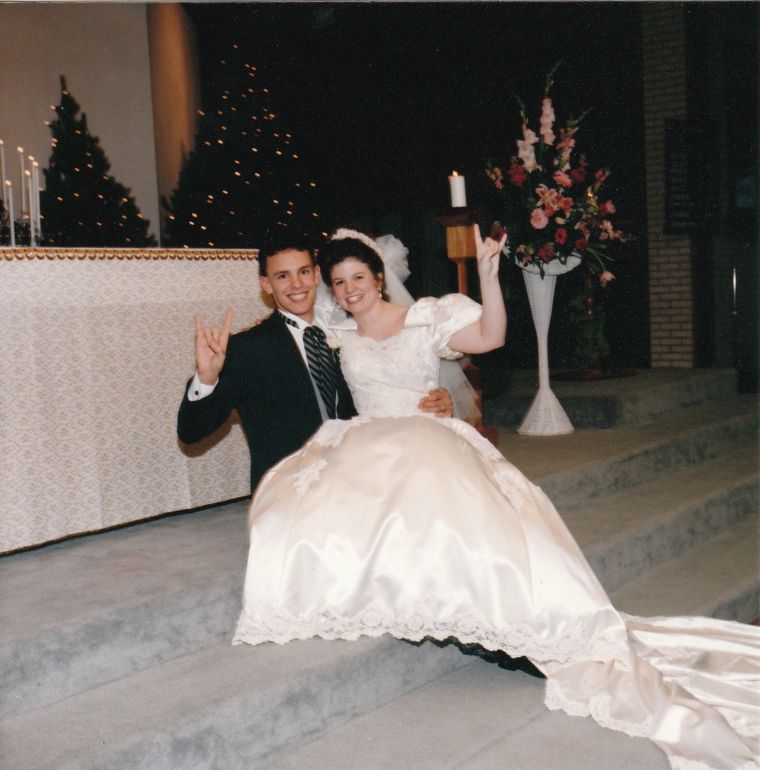
Twenty five years ago today they exchanged their vows at St. Frances Cabrini Catholic Church. It was a beautiful service shared with a crowd of friends and relatives. Maryellen glowed with the flush of love and anticipation and Scott had “the look” in his eyes that assured me that he would be forever faithful and loving to my daughter. Our family priest John Perusina said the mass and Scott’s Lutheran minister assisted with the proceedings. The bridesmaids wore blue and one of Maryellen’s childhood friends sang Sunrise, Sunset like an angel, making everyone in attendance cry as we recalled how quickly the years had gone by since the bride and groom had been children. It was a gloriously happy day that bode well for the future.

Maryellen and Scott moved to Beaumont after a memorable honeymoon in Yosemite National Park, yet another idea of Scott’s that was so perfectly suited to Maryellen. They set up housekeeping in a cute apartment and began their careers. It was a fun time and it was wonderful to see how happy they were and how well things were going for them.

Eventually Scott received an offer that he couldn’t refuse from a firm in Indiana and so the two of them were on the move. They purchased a lovely house in Lafayette and began to explore the midwest during their free time. They were only two hours away from Chicago and so that exciting city became a frequent destination. It was a time filled with new adventures and new confidence for them when all of us realized that they had indeed become a powerful team.

Four years after they married their first child, Andrew, was born and our visits to Indiana became ever more frequent as we enjoyed visits with our grandchild. I always felt so intensely happy to see the relationship between Maryellen and Scott growing ever stronger and thus it would be as one year flowed into the next and three more children joined the family as they moved again to Beaumont and finally back to the Houston area.

Maryellen and Scott have been models of love and dedication. They are beloved pillars of of their community known for their dedication to being exceptional parents and generous neighbors. They inspire others with their devotion to each other and to their sons. Together they have weathered the rollercoaster ride that is life and managed to overcome every challenge that appeared on their horizon.

In a very troubled world where it almost seems old fashioned to hold tightly to values and traditions Maryellen and Scott Greene have proven that the power of love is still one of the most priceless treasures that any of us might possess. For twenty five years they have steadfastly honored one another and passed on their mutual love to their sons who are growing in the same wisdom and age and grace that they have so beautifully exhibited.

Somehow I am overwhelmed by the rapid passage of time. In my mind they are still the twenty something young adults with so much hope in their eyes and a whole lifetime ahead of them. They have done a remarkable job of cherishing the promise that they made on that day in the glow of tiny lights from the Christmas trees on the altar. They have fulfilled all of their vows and done the hard work of keeping the flame of their never ending love alive. It makes my heart burst with joy to know that they are such incredibly fine people.

Happy Twenty Fifth Anniversary, Mr. and Mrs. Greene. May you enjoy many more wonderful days together as you share a special love. You are a blessing to all of us.

Weird

9.-Chocolate-Hills-1113-64390-1680x1050.jpgWhen I was a kid one of the local television stations had a Friday night program called Weird. It came on after the ten o’clock news and featured mostly B grade science fiction movies that were great fun to watch. I rarely missed an opportunity to stay up late viewing Godzilla monsters and aliens from outer space. I suspect that my taste for stranger things began way back then, and my interest in the truly wild and ridiculous has never abated, which brings me to last year when the world appeared to lurch forward into some of the most improbable situations since I watched those apocalyptic films of my youth.

I have to admit that I have not yet grown accustomed to the disquieting nature of the tweets from our president. I find myself uncertain as to whether his outrageous boasts are the product of a madman or a genius. Just when I think that I have heard it all from him, he performs the astonishing trick of outdoing himself with an audacity that is both concerning and sadly amusing. I truly wonder if his antics with regard to the certifiable leader of North Korea will result in war or somehow manage to protect us in a twisted way. I seriously don’t know what to make of his put downs and ignorant commentaries and I find myself searching the news each morning to determine the latest flap from the most recent tweets. I suppose that I should be somewhat immune after an entire year of such commentaries but I never fail to be astounded, which may in fact be the president’s intent. He certainly gets noticed and makes it virtually impossible for me or anyone else to follow the old dictum of ignoring bad behavior and rewarding good to condition an individual to adopt the proper ways of doing things.

Last year was not only weird because of the audacious rants of the leader of the free world, but even Mother Nature decided to act out. It was definitely a record year for natural disasters that ran the gamut from devastating floods to horrifying fires. It was as though we humans lost all control and were put in our place by climate gone wild, and the churlishness continues with one of the coldest winters in recent years. I feel certain that someone with a bent for writing science fiction is already imagining a great story about our dramatic weather and the chaos it has been inflicting on us. It is as though the natural world is asserting itself and letting us know that we are not as in control as we often assume that we are. I’ve always believed that we need to show a bit more respect for our planet and its workings and maybe that was the message that we were sent last year.

I have to admit that all of the revelations about sexual harassment were a bit strange as well. So many people toppled from their pedestals of power in such a short time. I’m a bit befuddled as to why it suddenly became in vogue to actually listen to victims and chastise offenders so swiftly and uniformly. We’ve literally ignored the pleas in the past and were more likely to accuse the accusers of lying while protecting the accused. While I think that it is good that we are ferreting out some of these horrendous abusers I worry a bit that in the frenzy there will be some innocents unfairly losing their reputations. I think it is important that we be careful that we are a nation based on the idea that everyone is presumed innocent until proven guilty. Our rush to judgement must indeed continue to be based on the law. It’s wonderful that we are finally willing to listen to those who have been mistreated, but we must also give pause to an instinct to accept all stories without benefit of proof. I certainly don’t want to return to days when people courageous enough to step forward were thrown under the bus, but it’s never good either to automatically assume guilt.

We had some very strange news stories last year including one in which a group of researchers asserted their confidence that there are indeed aliens living in the universe with us and we are moving ever closer to meeting them one day. Then there was the shooting in Las Vegas which was horrific in every imaginable way including the fact that there was no sign of a motivating force for the perpetrator. Everything about that incident was incredibly odd. The same might be said regarding the rallies in Charlottesville that ended in death and mayhem as Alt right groups marched through the streets carrying tiki torches and Nazi flags. It was an ugly sight by anyone’s standards made even more concerning by the fact that far too many actually found excuses for the actions.

Weirdness can be entertaining but the kind we had last year made me wonder if those old movies depicting the end of civilization as we know it were a bit prescient. As long as we are unable to unite in pursuit of peace and justice it feels as though we are set squarely in the middle of The Twilight Zone. The annual marathon of that iconic series somehow didn’t feel as farfetched this year given the real life strangeness of 2017. I’m crossing my fingers that 2018 will provide us with a break from all of the craziness, but I find myself fearing that we are in for another bumpy ride as long as the Middle East remains in a state of chaos and Rocket Man and the One with Orange Hair spar over who has the biggest nuclear button. I’d choose to just laugh at the antics if the stakes were not so high. It only takes one false move to send the world into flames and create the kind of dystopia that was the stuff of those old movies on Weird that I so enjoyed.

I suppose if I have one wish, one prayer, it is that the people of the world find ways to come together to end the hatefulness and violence. I suppose that we ordinary folk have been silent for far too long. The good citizens of Alabama showed us how to harness the power of good, and we need to seize the moment. The message that we must send is that we have grown weary of being the pawns in a weird story produced by leaders who only seem to want to constantly argue. A bit of calm and boring security is all that we really desire. Here’s hoping that we find it this year.