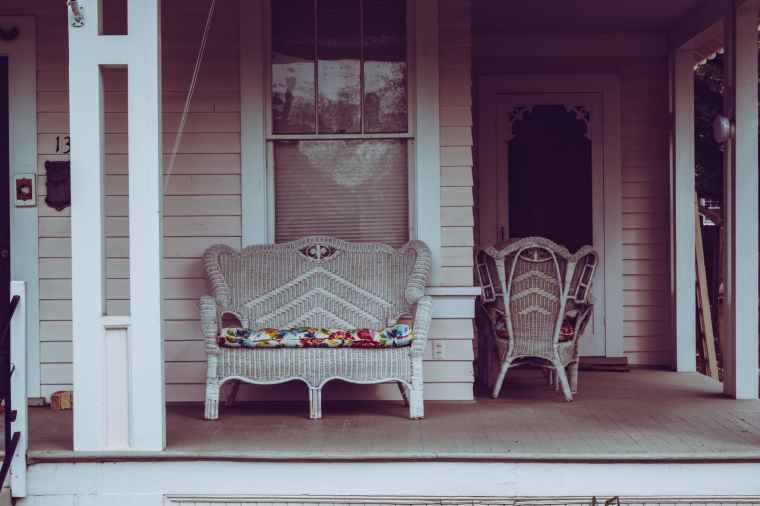
The Front Porch

white wicker padded bench
Photo by Brett Sayles on Pexels.com

There was a time when almost every house had a front porch, a place where family and friends would gather just to sit and relax and watch the world go by. People didn’t need an official “night out” to shout a greeting or wave at neighbors. They’d simply gather in the morning with their cups of coffee to watch the children scurrying off to school or in the evenings with a cool drink just to enjoy the glory of day’s end. It’s rare to see homes being built with porches in the front anymore. Instead we design our living spaces for ultimate privacy by placing our outdoor retreats in back of our homes where we are hidden from the rest of the world. Perhaps it is just one more sign of the times when we often feel isolated and unsure of our places in the big picture.

Visits to my paternal grandparents always included time spent on their expansive front porches which my grandfather enhanced with screen to keep the bugs out and to insure that even when the mosquitoes were having a roaring good time, we’d be enjoying ourselves as well without worrying about getting bitten. My grandparents always had the area furnished like an additional living room with a sofa like glider, rocking chairs and lots of extra seating. Grandma made sure that we had an endless supply of cool drinks and Grandpa kept a big fan in perfect running order to provide us with comfort. We’d join in the greetings of neighbors who passed by while on their walks and sometimes climbed up the steps to the house to spend a few extra minutes to find out how everyone was doing. We watched the birds during the day and fireflies at night, and talked of people, events and ideas. Somehow the time spent on their front porch always made me feel safe, content, proud and loved.

My maternal grandmother had a front porch as well. Hers was not covered or enclosed which was actually preferable to all of us cousins who gathered there every Friday evening while our parents played poker inside a tiny room so filled with smoke that it made us gag. We enjoyed the freedom and adventure of the outside with that porch serving as home base for the crazy games that we invented for our entertainment. Sometimes my grandmother would quietly sit in our midst, but because she rarely spoke it never occurred to us that she may have been watching over us. We just thought that she was escaping the raucous conversations of her children and enjoying the cleaner air on her porch.

None of my homes either as a child or an adult have boasted a front porch. I suppose that trend lost its charm for builders sometime in the middle of the twentieth century. We hosted our gatherings in our backyard where we might enjoy more privacy without interruption. The front of the house was reserved for coming and going and quick waves of the hand at our neighbors. Only once in awhile would we bring our lawn chairs to the front yard to join adventurous folks who decided to resurrect the old ways of relaxing together after long days of labor. I so enjoyed those sojourns with the Halls and the Turners and the Mayfields on somebody’s lawn when we would watch the children playing and laugh as our cares drifted away.

I rarely see people gathering in front of their homes anymore. Such enjoyment has in many ways become a thing of the past. Perhaps we are too rushed or too private or too wary of being on display. Maybe we don’t want to fight the heat or mosquitoes. For whatever reason we mostly stay enclosed in our own private worlds and seem to think it necessary to wait for special invitations to meet up with our neighbors. We know that there is life inside the homes on our street but it is only the passing of cars from the garages that alerts us to that fact. The old ways of lounging together outside on a summer’s eve are mostly the domain of the past.

Now my husband and I sit around the table on our backyard patio listening to the cooing of the doves and sounds of the people around their swimming pools or on their trampolines. Their dogs bark at us as we survey our garden and once in a great while a voice from behind the fence will ask us to retrieve a wayward ball that has found its way onto our space. Most of the time our contact is minimal and we get the idea that everyone prefers it that way.

My father-in-law has a lovely wrap around front porch at his house that was originally built in the early days of the twentieth century when such a feature was all the rage. He rarely sits out front preferring the deck in the back of the house instead. When I visit I imagine festooning the front porch with sumptuous ferns and plants. I think of placing a small table with chairs out there where one might enjoy a meal or a cup of morning coffee while watching the passersby. I suppose that I would wear out the swing that my husband and his best friend once hung so that my mother-in-law would always have a place to sit. I’d wring out all of the enjoyment that the front porch was intended to provide. Sadly I’m not sure that I would see much because I rarely observe anyone passing by whenever I go to visit. It seems that even those with the wherewithal to enjoy the neighborhood from the front don’t bother to do so anymore.

Front porches seem to have become a thing history, a pleasant memory of bygone days when the windows were open and the doors were unlocked. A neighbor need only shout a greeting from the sidewalk to be invited to come sit awhile. Everyone knew everyone else and there was an unspoken duty to watch over the children as they played. We were open and unconcerned with things like political differences. The whole neighborhood was one great big happy family. Along the way our televisions and phones and air conditioners lured us inside and pushed us at the back of the house. Maybe it’s time that we come back out to the front.

Finding Hope

people gathered inside house sitting on sofa
Photo by Daria Shevtsova on Pexels.com

Statistics can be a powerful way of understanding trends in our society, but they can also be misleading. Learning the truth about the numbers that we see requires analysis, critical thinking. Since we are continuously bombarded with information regarding the state of our world based on statistics we need to consider what that data is actually telling us. Something as simple as the intervals of a graph has the power of visually changing the way we interpret the facts. So it is with the ever recurring claim that the lifespan of the average American has continued in a downward direction since its apex in the nineteen sixties. It’s important that we begin to understand what that bit of information actually means, and what we may need to do to halt the decline.

We are often told of the need to improve medical care in this country by the use of this astounding statistic. For most of us it simply seems almost impossible to believe that we have such phenomenal medical facilities and still are losing the battle of saving lives, and yet it is real. A deeper analysis demonstrates that the downward trend is related mostly to alcoholism, drug abuse, and suicide. It is not so much that our country is lacking in quality medical care as that we have an epidemic of self harm that results in deaths from overdoses, cirrhosis of the liver, and increasing numbers of suicides, especially and shockingly among our middle age population. It is a quiet and grim trend about which we say little, but it is prevalent all across the country and most particularly in areas where businesses have failed and lifestyles have drastically changed.

HBO in conjunction with Dr. Sunjay Gupta filmed a documentary called One Nation Under Stress that attempted to get to the heart of why so many are turning to drugs, alcohol and even death as answers to problems. We know that addictions can be difficult to overcome, but what attracts people to chemical means of coping with anxiety in the first place? Why are ordinary middle class individuals in so much pain that they feel compelled to shut out their sadness with chemicals that alter their brains and damage their health?  What is really happening?

Dr. Gupta and the experts that he consulted note that our society is continuously and relentlessly changing, particularly in small towns that often rely on particular industries for the welfare of the populace. Many of the old avenues for work are being eliminated and in the process people find themselves suddenly left with no meaning or income in their lives. The losses that they incur both physically and emotionally drive them to seek solace in harmful ways or to despair entirely. Additionally our society has lost many of the support systems that were once so prevalent. The extended family units and neighborhood associations that were once so common have crumbled in many ways leaving individuals feeling alone and unable to cope. In fact, a certain irony is that recent immigrants are actually doing better than long time citizens because they cling to one another in communities that emphasize care and support.

Those in the middle of the economic spectrum are the most likely to feel the weight of stress. They are subjected to a kind of collective pressure and worry about losing their status and all of their comforts. They often feel quite alone in their struggles and so the abuses to their bodies and minds begin. They are reluctant to share their concerns, and often feel that they have nobody whom they trust enough to do so anyway. The anxiety bears down on them both mentally and physically.

I experienced a kind of microcosm of such feelings during the rains of hurricane Harvey which so inundated my city. My husband Mike and I were alone in our home hearing reports of devastation that was affecting both strangers and dear friends and family. Mike had suffered from a stroke only a few weeks earlier and we had been told that his chances of suffering from another attack were at their highest during this time. I was quietly frantic with worry, so much so that I was hardly sleeping and had to keep my mind occupied by preparing my home for the possibility that it might flood. When my daughter and her family had to leave their neighborhood for fear that the levee that protected their home high fail I felt incredibly alone with the realization that they were now so far away and Mike and I were so isolated from everyone. It was a series of reassuring texts from a former student who assured me that he was on alert if Mike and I needed a rescue that kept me from totally losing my composure. The lifeline that he gave me quelled my fears as did the random meetings with a neighbor across the street with whom I spoke as we both assessed the drainage system that was working to keep the water away from our homes. Facebook also gave me a way of knowing what was happening to friends and members of my family. It provided me with a way of expressing my anxiety rather than bottling it up inside. Ultimately I made it through those horrific days, but I found myself wondering if it would have been possible without those human connections that kept me grounded.

What happens when a person feels that there is no one to help? How does one cope when the pressure is not for just a few days but over a long period of time? What might each of us do to help those who have lost their way? Do we sometimes underestimate the power of a text, a message, a phone call in changing the tenor of a person’s thoughts? Have we emphasized independence so much that we have lost the emotional support of multi-generations living and working together?

Mike and I were recently discussing the Great Depression. Our parents were children during that time. It was our grandparents who bore the full brunt of that era. We noted that they survived by sharing responsibilities and resources. Whole families of sons and daughters and cousins and grandparents pooled their funds and their food to keep afloat. It was a cooperative effort that brought our ancestors through the tragedy. Hidden in their efforts was a great deal of love. Our people understood that the were going to make it because so many cared about the welfare of each individual.

We would do well to reinstate the power of family and neighbors to ease suffering. Old people should feel assured that they will find the care that they need if they become sick. Young folk should know that they will have the encouragement and support to launch themselves as adults even when they make mistakes. Those in the middle should never be reluctant to ask for help when things go awry. If we open our hearts and begin to embrace the people for whom we care perhaps we can stem the tide of self medication and self destruction that is literally killing people in our midst. The change that we need is to be found inside our relationships. If we focus on strengthening them many of our problems will be solved.

Learning by Doing

toddler climbing on wall
Photo by Susanne Jutzeler on Pexels.com

The warm weather has been a bit long in coming this year which is just fine with me. I don’t want to live in northern climes where winter lingers until May. Nor do I wish to deal with snow and blizzards, but I do prefer cooler weather that allows me to dress in layers and wear cute boots. My figure is long past the showy stage. The less skin I expose, the better for multiple reasons not the least of which is my tendency to get skin cancers. Too much sun leaves freckles and brown splotches on my face, and my waistline is hardly bikini worthy. Fall and winter fashion serves me best. I can fool the world into thinking that I’m still slender. It’s amazing how many sins a nice long sweater can hide.

Nonetheless  I remember my childhood when I longed for the warmth of the sun, even though my family did not own an air conditioner. How we managed to survive the hot Houston summers with only  open windows and an attic fan is beyond me, but I don’t recall feeling unduly uncomfortable. I suppose that we humans adapt to whatever is customary, and back then summers meant wearing very little clothing and eschewing footwear in favor of bare feet. We’d found comfort under the shade of trees or through strategically created ventilation from open windows. Of course an invitation here and there from a friend whose home was mechanically cooled never went unanswered. Now I don’t think that I would make it through a summer without my thermostatically controlled coolness, and I certainly am no longer willing to reveal the true nature of my physical shape by wearing skimpy outfits.

I wonder what we would do if we were somehow forced to return to those days of ninety degree temperatures inside our homes. To hear some scientists’ claims it could very well happen again. We might once more have to learn how to deal with whatever Mother Nature sends our way. It will take a great deal of cleverness like we used back in the day. For now I’ll just be glad that the continuous state of sweat is but a distant memory, made pleasant by the selective nature of my mind.

I laugh when I think of how my generation grew up. In today’s world our mothers would be reported to CPS for doing things that were just natural back then. We rode in cars without any kind of seatbelts, sometimes even standing on the seats, riding in the front, and hitching rides in the back of pickup trucks like cargo. We had no kneepads or helmets for skating or riding bicycles which we often mounted in our bare feet. We stepped on nails and glass and as long as our tetanus shots were up to date our moms cleaned our wounds, splashed some mercurochrome on them and finished with a bandaid that fell off within minutes of our returning to the streets without benefit of shoes.

We played games in the middle of the road, and Red Rover was one of our favorite neighborhood competitions. We almost always sported scabs on our knees and cuts on our fingers. We’d cool down with water from the hose which also served as our drinking fountain. We roamed the area in little hoards finding adventure down by the bayou or in walks along the railroad tracks. We all knew the sting of hot asphalt on the soles of our feet or sticker burrs between our toes. We’d have make believe battles with the little berries on tallow trees, tossing those makeshift weapons like grenades. I don’t remember anyone losing an eye, but I  suspect that somewhere some poor kid may have been injured in that way.

We were as free as Tom Sawyer and Huckleberry Finn and just as inclined to mischief. We’d scale mountains of sand meant to be spread on some neighbor’s yard. We’d climb roofs and stand on the peaks like intrepid adventurers who had successfully scaled some high peak. Nothing was out of the bounds of our imaginations and in the process we got tough and learned how to work as teams. We thought out of the box, inventing ways to have fun without many store bought tools.

Summers were great times when we were free as the birds in the sky, little noticing the stifling heat that hung over our childhood games. Now I get weak in the knees and short of wind if I attempt to be too energetic in the hottest times of the year. I’ve grown far too accustomed to the luxury of central air conditioning to submit myself to the tortures of the sun. In some ways it makes me sad to admit that I have lost my toughness. I was once like a young warrior ready for any challenge regardless of the weather. Now I am more like a hot house flower, as I suspect most of us, including many children, have become. So yes, the cooler times of year are now my favorite. That’s when I don’t mind taking a many miles long walk or working all day in my garden. To my utter delight of late there have been more days suited to my taste than usual.

I’m still admittedly proud of the way I grew up. I sometimes think that the “greatest generation” that raised me understood how to treat children far better than we do today. My friends and I have glorious memories of fun that don’t appear to be duplicated by many young folk today. Children have their play dates and formal classes which I suppose are fun, but I worry that they don’t have enough experience in which they make all of the decisions without adult supervision. There’s something quite wonderful about working things out by trial and error. It is a glorious way to gain all sorts of knowledge. The warm weather always reminds me of my outdoor classroom and all of the things that I learned by doing.

A Month of Madness

close up photography of blue and green smoke
Photo by rawpixel.com on Pexels.com

As I took my plants back outside after a couple of days of freezing weather I thought of how cyclical life is. I’ve been through seventy one winters now and watched the seasons change in quirky ways, but always somewhat predictably. Life is a series of repetitions during which we grow just a bit older and hopefully a bit wiser. We learn about the way of things and understand that while it’s unusual, it is possible to have a freeze in March in the south. We go with the flow and the routine even as big changes may occur to make things so very different. We understand that we can count on the calendar moving at its”petty pace” but surprises both good and bad may come our way at any moment. The traditions to which we often cling are ways of keeping us anchored even as storms roar around us.

March brings us the Houston Rodeo and Mardi Gras and Lent and the madness of basketball. In this month we celebrate St. Patrick’s Day even if we don’t have an Irish bone in our bodies. We decorate our homes with colorful beads and then replace them with shamrocks and finally bunnies. We take a break from work and school with an eye toward warmer days and fun in the sun, hoping that our plans to visit a beach aren’t spoiled with rain and cold temperatures. We seek a sense of control and continuity with our rituals. They create cohesion and memories that sustain us, but they can also be a source of sorrow when things spiral out of our control as often happens.

I remember a year when my friend Pat secured a beach house for all of us to use during spring break. Our children were teenagers who were not yet driving and doing things on their own although they may have been dying to do so. We happily packed enough food and clothing for what should have been a fun adventure, but things began to fall apart almost immediately beginning with the fact that we had to wear coats because it was so chilly. Nonetheless, by the time we had reached the rented house we had outlined a Plan B that did not include swimming in the still frigid ocean, but would still be filled with tons of fun. We were bound and determined to make the best of our situation.

As soon as we opened the door of the vacation home we somehow knew that even our alternate ideas were doomed. The place reeked of deceased rodents and there was no way that we were going to be able to stay inside. At that point our anger and disappointment reached its limit. We had no choice but to complain to the owner of the place and then return home. After shedding a few tears of frustration we were on our way back to where we had started with only a few lame ideas about how to have a fun time in spite of the frustrating developments.

I don’t remember what we actually did after that. I do know that we eventually found ourselves laughing in a kind of hysteria about how awry things had gone. At the time our misadventure had seemed so significant and horrific but as the seasons came and went and our children grew into independent adults the story of that spring break became more of a treasured memory of our continuing friendship than a terrible experience. Today my friend Pat is gone and I know in my heart that I would even stay in a stinky rat invested house if it meant that we might have a bit more time together. Such is life.

After someone dear to us dies the first few cycles of the the year are exceedingly difficult to endure. Each occasion reminds us of how much we miss them. Over time our wounds heal, toughen up, and turn into scars. We once again find joy in our traditions and the memories of those who once shared them with us. We realize how lucky we were to have them and the pain becomes bearable. Just as the dormant trees bud forth each spring, so too do we find ways to carry on even after we have felt as though we too have died inside.

I love this time of year. It is one of those grandly transitional months when we humans find ways to muddle through the last gasps of winter with the promise of spring just over the horizon. We gather together to celebrate all that has gone before and all that is yet to come. Our hats, parades, ashes, decorations, foods, and gatherings are inventions of the human spirit, attempts to maintain our optimism even when everything around us feels so wrong. How wonderful it is!

March is a hopeful month even as we witness destruction from the last gasps of wintery weather. It’s a month when we never quite know how things will turn out, but we plan them anyway. We may go to the Houston Rodeo in heavy coats with rain falling on our heads, but once we are inside the arena all of our worries seem to evaporate. March is ever a new beginning, a time to set the problems of the past aside and hope that better days are ahead. It’s also a time to prepare ourselves for whatever challenges may come our way by thinking outside of our own worries and needs. I’m now old enough and experienced enough to know that it’s often a month of madness that always seems to end with a feeling of peace.

A Joyful Presence

heart shaped red balloon
Photo by rawpixel.com on Pexels.com

Eileen and her big family lived within sight of the church and school that I attended when I was growing up. She was a beautiful girl with long blonde hair and a welcoming smile. She was also very smart with a level of confidence that I was still hoping to find back then. By the time that we were in high school we were scheduled for the same classes with the same teachers and our friendship blossomed.

Eileen sometimes got to take her family’s  van out for a drive, thus becoming the designated chauffeur for our group. She’d take us to Friday night football games, days at the beach, and now and again a special concert like the time when we saw the Beach Boys. I adored her and counted myself lucky for being invited to partake in so many fun times with her and the rest of our friends. Some of the very best times of my teenage years were spent with Eileen.

Of course things change after graduation. Eileen and I went our separate ways. From time to time I would hear about what she was doing and where she was living. I knew that she had become a nurse and ended up in Washington state. I suppose that I should have made an effort to contact her to see how her life was going, but the world intervened and created a busy schedule for me. I was caring for two daughters, teaching, taking classes, and being a caretaker for my mother.  Somehow I barely kept up with my responsibilities and so I never found the time to reach out to Eileen. Nonetheless I often thought of her and remembered how much fun she had brought into my life. I hoped that she was doing well.

It was not until our fiftieth high school reunion that I saw Eileen again. She was as beautiful and as sweet and friendly as ever. She had a daughter and a handsome husband who seemed to adore her. She enjoyed living in Washington State and was hoping that some grandchildren might be in her future. We traded addresses and reignited our friendship on Facebook. I so enjoyed catching glimpses of her world. Over time I learned just how faith filled she was.

Eileen battled breast cancer for a time after I was once again in contact with her, and during that time she inspired those of us who read her optimistic posts that demonstrated her determination and belief that God was by her side. We rejoiced when her weeks of treatment resulted in a positive outcome, and celebrated even more when she announced the birth of her first grandchild. As when we were both young, I found myself in awe of this wonderful woman who somehow offered hope and happiness even in her darkest hours. It was so fitting that life appeared to be falling into place for her with long golf games and photos of lovely moments with her grandchild.

It never occurred to us that Eileen’s cancer might return, but it did. The news was difficult to accept, but as always seems to be the case with Eileen she was soon attempting to soothe our concerns. She stoically insisted that she had the very best doctors as well as the comfort of God to guide her through her latest journey with cancer. Even with her courageous spirit we saw how hard it was for her and so we began to pray.

Eileen keeps us updated on her progress. Some weeks leave her exhausted and without even enough energy to let us know how she is. Others seem to revitalize her. Always she tells us how wonderful God is and how she has doctors in whom she places all of her confidence. Inevitably I find myself thinking of her all day long, praying each morning and evening that the outcome of her battle will prove to be positive and with as little pain as possible.

Recently one of our classmates started a prayer chain for Eileen. It didn’t surprise me at all to learn how beloved she was. She has always been a generous and giving person to virtually everyone. She is open and honest in ways that few of us possess, so much so that I still find myself wanting to be more like her when I finally grow up. I want more than anything for the power of love that we are directing her way to gird her and comfort her.

It amazes me how neither time nor distance has the power to destroy the feelings that we have for another person. Eileen was and will always be quite special to me. She kindly took the gawky unsure teenager that I was under her wing. She made me laugh and feel good about myself at a time when I sometimes thought that I would always be a misfit. She still has the power to make my day with her smiles and her serenity. She is truly a joyful presence, a living angel. I only hope that she knows just how much she has impacted so many lives and how ferociously we are praying for her.