Yesterday Today and Tomorrow

default-1464355425-834-scientists-believe-they-have-explained-the-great-flu-outbreak-of-1918A hundred years ago in the fall of 1918, there were many who seriously wondered if the world was coming to an end.  A great war was still raging in Europe and decimating the young male population. Across the globe there was unrest and a general feeling that life would never be quite the same again. The worst surprise of that autumn was to come in the form of a tiny virus not yet visible to the human eye with the microscopes of the day. It would lead to an outbreak of influenza that eventually killed as many as five million people worldwide and hundreds of thousands in the United States. One sneeze from an infected person had the potential to infect ten thousand, and for a time nobody knew what to do.

It appears to have begun at a military base in Kansas where it was first thought to be little more than the typical seasonal outbreak of illness. It soon became apparent that the new strain was unlike anything doctors and biologists had ever before seen. It started with coughing and a fever that quickly grew ever more severe. It filled the lungs of the ill with so much fluid that they literally drowned. Before long there were not enough beds or doctors for the affected, and not enough coffins for those who died. During the months of September and October of that year the disease spread like wildfire, sparking dire accusations that the Germans had somehow planted germs in the bodies of soldiers fighting in the trenches. The fact that German troops were just as susceptible to the sickness did not allay the fears of those who were losing loved ones and friends so rapidly that it felt as though there was nothing that was going to stop the rampage of death.

More American citizens died during those weeks than in all of the wars of the twentieth century, and yet there was no cure, no idea of what the cause might be. For some reason the virus was more likely to spare the very young and old, but was most deadly for strong and healthy adults in their twenties and thirties. It would be years later before researchers found the virus that had wreaked such havoc on the population, and began to understand that the sickness had burned itself out when those who survived became immune without any form of medical assistance. Our understanding of such diseases grew over time, but always there continues to be a silent fear that something similar may one day return to infect humanity like a plague.

I had never heard about the horrific influenza of 1918, until I read a book shared by my daughter. She is a nurse and science teacher who has a great deal of interest in such things, and she thought that I might find the topic interesting as well. I was stunned to learn about the horrific events and to realize that none of the older people I had known who would have been young adults during that period had ever mentioned the event. I was particularly surprised that my grandfather who was well known for his vivid stories of the past had not brought up the topic. Since I was unaware of that part of history I had not known to quiz him about what he remembered regarding that sad chapter, and so I was not privy to his eye witness account.

Historians conjecture that this particular episode must have been so personally horrific that those who had endured it did not want to speak of it again. Perhaps it was the impetus for the roaring liveliness of the twenties when people appeared to throw all caution to the wind. Living through such tragedy must have caused people to view the world much differently than they otherwise might have. Most certainly they would have wanted to blunt the memories that must have been quite horrific. When the next decade of frivolity was followed by a worldwide depression and eventually another war, the personal stories of illness and death might have seemed trivial to them by comparison. In truth, they would have been right to wonder if the bad news would ever stop, and when it finally did they most probably decided never to speak of it again.

My father-in-law served in Korea during the war there. He has only mentioned what he saw there once in all of the years that I have known him. His eyes filled with tears as he recounted his experience and his voice was shaky. It was much too painful a memory for him to think about for very long. I have noticed that my uncles who fought during World War II were just as reluctant to share stories of their adventures as were my peers who fought in Vietnam. I suppose that there are events that are so horrible that we prefer to bury the thoughts of them deep within our psyches. It is simply too much to dwell on them for very long. 

I suspect that those who were witness to the 1918 influenza epidemic simply did not want to speak of the unspeakable. They lost loved ones and friends in a matter of days and weeks. They worried that the horror might return at any moment. To dwell on their heartbreak and fears would have been unbearable and so they did not include mention of the outbreak in their tales of living. The story languished until curious souls began to ferret out the details and bring them to light once again. What is a curiosity for those of us removed by a hundred years was all too real for those who were there when it happened.

Each generation has its share of tragedy. For those of us who grew up just after World War II the events etched permanently inside our brains include the good, the bad and the ugly. We recall with clarity exactly where we were when John F. Kennedy was assassinated. It pains us to think of the deaths of Martin Luther King, Jr. and Robert Kennedy that made is wonder if anarchy was going to rule the day. Many of have personal tragedies that affected us as well, the death of a father or hearing that a friend was killed in Vietnam. We smile when when we think of the first man to walk on the moon, and recoil at the vision of the twin towers in New York City falling like toy constructions before our eyes. These things affect us and change us and our ways of viewing the world, but we don’t often speak of them because the thoughts associated with them are too powerful and emotional. I suppose that the reality is that no matter how conversant we are there are no words sufficient to describe such things, and so we are silent just as my grandparents were about so much of the history that affected them.

Today we have new worries, but mostly go about our business hoping and praying that none of our biggest concerns will ever take place. Our natures compel us to be optimistic and to carry on even when situations seem dire. Like Scarlett O’Hara we believe that tomorrow will be a better day and we concentrate our thinking on the future rather than the past and the present. It’s how we survive. Still, there is something so fascinating about events like the influenza epidemic of 1918, that we can’t avert our gaze. We have to look if only for a moment so that we might remember that we are not immune to the same kinds of heartbreaking situations that plagued our ancestors. We are as human as they were, and we can only hope that when faced with tragedy we will respond well and not be judged too harshly for any mistakes that we make.

It’s all too easy to form opinions of what might have or should have happened. but we will never know what we might actually have done if we had faced similar hardships. It must have been a dark time, but somehow those who came before us found a way to keep moving forward without focusing too much on a past that they could not change. Perhaps we might learn from them and embrace each new day as an opportunity rather than dwelling on the heartache of the past. Yesterday is gone, today is an opportunity, and tomorrow allows us to repair any mistakes we have made. It’s the cycle that keeps the story of humanity alive. 
Love Honor Cherish

15975072_10211601975865667_328586816067567646_oParenting is one of the most difficult tasks that we humans attempt to master. It pains us to see our children hurting, but we know that we will never be able to completely eliminate struggles from their lives, so we teach then how to effectively deal with both trials and tribulations. We hope that our foundation will help them when we launch them into the adult world. Mostly we pray that they will know how to surround themselves with good people who love and care about them as they begin their independent journeys without us. So it was with my two girls.

Like any other parent I did my best and hoped with all of my heart that my efforts would be enough. My eldest Maryellen had always made me proud, and she appeared to have a good head on her shoulders as she left our home to become educated by others at the University of Texas in Austin. There were some shaky moments in her early days there when I received phone calls and heard the strains of uncertainty in her voice, but she managed to make it through the rough patches and secured a place for herself among friends both new and old. Along the way she met a young man named Scott through the encouragement of one of her more gregarious friends.

At first Maryellen was tentative about being more than just a good pal to Scott, but before long she was drawn to his good nature and his intellect and they began to date. Her face would light up whenever she spoke of him and I could tell that her relationship with him was far more special than any that she had ever experienced. He had a way of understanding her and treating her as an equal that pleased her. Even his gifts to her at Christmastime were astutely thoughtful and romantic. I found myself believing that she had found the man of her dreams and when I finally met him I was pleased to sense that he was a truly good person who respected and cherished her as much as I did.

Maryellen and Scott enjoyed a delightful courtship at the university, peppered with serious study sessions and fun times with a group of remarkable friends. They cheered the Longhorns at football and basketball games and enjoyed the same music and movies. Mostly they talked and realized how neatly their hopes and dreams meshed with one another. They fell in love.

I was quite pleased when they announced that they were engaged. They were both mature and thoughtful individuals who had transitioned well into adulthood. They both were within striking distance of earning degrees in the respected fields of business and engineering. Their futures were promising and together they were certain to be a power couple, but more importantly they shared values that would help them to build a life of love and devotion.

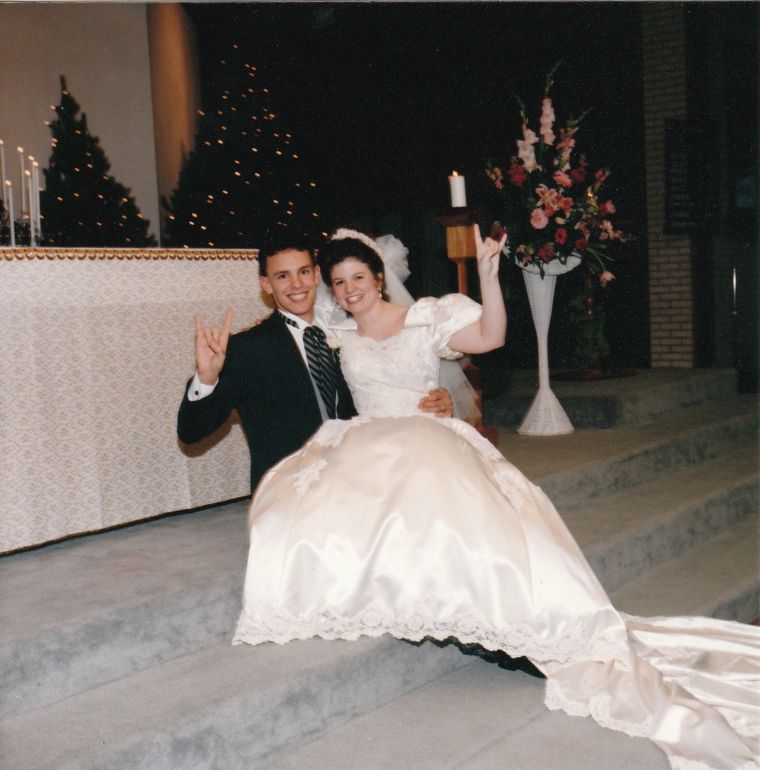
Twenty five years ago today they exchanged their vows at St. Frances Cabrini Catholic Church. It was a beautiful service shared with a crowd of friends and relatives. Maryellen glowed with the flush of love and anticipation and Scott had “the look” in his eyes that assured me that he would be forever faithful and loving to my daughter. Our family priest John Perusina said the mass and Scott’s Lutheran minister assisted with the proceedings. The bridesmaids wore blue and one of Maryellen’s childhood friends sang Sunrise, Sunset like an angel, making everyone in attendance cry as we recalled how quickly the years had gone by since the bride and groom had been children. It was a gloriously happy day that bode well for the future.

Maryellen and Scott moved to Beaumont after a memorable honeymoon in Yosemite National Park, yet another idea of Scott’s that was so perfectly suited to Maryellen. They set up housekeeping in a cute apartment and began their careers. It was a fun time and it was wonderful to see how happy they were and how well things were going for them.

Eventually Scott received an offer that he couldn’t refuse from a firm in Indiana and so the two of them were on the move. They purchased a lovely house in Lafayette and began to explore the midwest during their free time. They were only two hours away from Chicago and so that exciting city became a frequent destination. It was a time filled with new adventures and new confidence for them when all of us realized that they had indeed become a powerful team.

Four years after they married their first child, Andrew, was born and our visits to Indiana became ever more frequent as we enjoyed visits with our grandchild. I always felt so intensely happy to see the relationship between Maryellen and Scott growing ever stronger and thus it would be as one year flowed into the next and three more children joined the family as they moved again to Beaumont and finally back to the Houston area.

Maryellen and Scott have been models of love and dedication. They are beloved pillars of of their community known for their dedication to being exceptional parents and generous neighbors. They inspire others with their devotion to each other and to their sons. Together they have weathered the rollercoaster ride that is life and managed to overcome every challenge that appeared on their horizon.

In a very troubled world where it almost seems old fashioned to hold tightly to values and traditions Maryellen and Scott Greene have proven that the power of love is still one of the most priceless treasures that any of us might possess. For twenty five years they have steadfastly honored one another and passed on their mutual love to their sons who are growing in the same wisdom and age and grace that they have so beautifully exhibited.

Somehow I am overwhelmed by the rapid passage of time. In my mind they are still the twenty something young adults with so much hope in their eyes and a whole lifetime ahead of them. They have done a remarkable job of cherishing the promise that they made on that day in the glow of tiny lights from the Christmas trees on the altar. They have fulfilled all of their vows and done the hard work of keeping the flame of their never ending love alive. It makes my heart burst with joy to know that they are such incredibly fine people.

Happy Twenty Fifth Anniversary, Mr. and Mrs. Greene. May you enjoy many more wonderful days together as you share a special love. You are a blessing to all of us.

The Builder

40e8039a1c47edf3e2821bc05c59f15a--basement-workshop-nail-storage-garage

There was a hardware store near our home that my father visited each Saturday with an almost religious fervor. It was a sacred place in which I ultimately felt the full extent of my father’s happiness. Happily he regularly took me on his weekly excursions and I always felt special as we wandered together through the aisles of tools and gadgets and fasteners while my dad explained the purposes of the different items. He was in his element inside that store and his face willingly gave away the happiness that being there provided him. Whenever I think of him I recall the bins of nails of every size and remember his lessons on why there were so many different kinds. I can still see him carefully weighing the proper variety for his latest project on the metal scales that hung from chains connected to the ceiling. I can smell the aromas of oil, wood, and metal that permiatted the concrete floors and the wooden studs of the walls. This was a cathedral dedicated to the carpenters, plumbers and electricians of this world. In Daddy’s case it was a shrine for all who love to build the edifices and implements that we use to bring us comfort.

My father never treated me as though I was too young to understand what he was doing. It didn’t seem to occur to him that as a girl I might not have been interested in the things that he so loved. He spoke to me about his passion for construction and explained the hows and whys of his work. Thus it was that he allowed me to sit at his side as he created a miniature replica of our first home. He carefully drafted a blueprint and showed me how to shrink the proportions of the rooms into a drawing that fit on a single sheet of paper. I could not have been more than four years old when he demonstrated the techniques of scale to me, for I had not yet started school when he first told me of his idea. Somehow Daddy assumed that I possessed enough intellect to understand his calculations in spite of my youthfulness, and he was so right. I was mesmerized by the process and willing to sit quietly on a stool while he demonstrated his skill at his drafting table.

The next phase of his work was to build a tiny house that would resemble our home in every imaginable detail. I was fascinated as he measured and cut pieces of balsa wood to create a frame for the structure. Even before he had inserted the walls and other features I was able to see the rooms unfolding just as I knew them to be. It took many weeks and many visits to the hardware store to finish the lovely reproduction. Sometimes weeks would pass before he had time to return to the task of making the tiny house that almost appeared to be the work of fairies rather than a man. I was astounded when it was finally complete because the details were so exact. He had somehow managed to create an illusion of cedar shakes and bricks and shingles that was a perfect copy of the house where we lived. He had designed the roof so that it could be lifted to reveal the interior rooms with their gleaming wooden floors and brightly painted walls. It was a masterpiece in my eyes and I felt a quiet joy in having observed the entire process. Sadly I have no idea what eventually happened to that wonderful creation. I would give anything just to see it once again and to explain to my children and grandchildren how wonderful it was to have been a witness to my father’s painstaking work.

My daddy was just as likely to educate me regarding other things that he built as well. When I was about seven we had moved to a new home and he was annoyed that we had to walk on the grass to get to the front door from the driveway. He muttered that the builder should have thought to create a sidewalk leading to the entrance. Before long he had decided to rectify the omission himself and once again he used the project as an opportunity to teach me about the proper methods for installing a concrete pathway.

He began by carefully digging out the grass in a pattern that resembled the desired design of what would be the final product. After seeming to take forever to level the ground and straighten the lines he next built a form with wood and and string, taking care to survey his measurements accurately. He allowed the structure to cure for a time to be certain that the ground was not going to shift. He also watched the drainage pattern and made adjustments to insure that there were not low points that would hold water. Then he began filling the bottom of the wooden platform with metal rebar and even bits of nails and other metal shavings left from other things that he had built. He told me that the metal was the secret ingredient for insuring that the sidewalk would last for years without cracks or erosion. Finally came the day when he mixed and poured the concrete spreading it until it was smooth and as perfect as he insisted that it should be.

Nobody was allowed to walk on his creation for days until he was certain that it was set exactly as he had hoped. He was quite proud of the outcome and so was I. Our neighbors commented on how nice it was and joked that they were going to hire him to build one for their houses as well. Daddy boasted that it was a fine structure that would last for a very long time. In fact it has endured even longer than he did. I recently drove past our old home and saw that the sidewalk was as strong as ever. It was not leaning nor did it have any cracks. It had withstood decades of use, sixty two years to be exact. As I saw how well it had performed I swelled with pride in knowing that my father had built it with his ingenuity and engineering skills. More importantly he had believed enough in me to share his knowledge with me, something that made me feel capable and appreciated.

To this very day I find great pleasure in sauntering through hardware stores. I especially enjoy the ones that are more in line with those of old. I prefer the bins of nails and bolts over the plastic packages that are the modern day norm. I consider an outing to Harbor Freight or Ace Hardware with my husband to be a delightful activity. Repairing things or building something is as much fun for me as taking a vacation trip.

I suppose that a psychologist would attribute my love of constructing to the tragic loss of my father when I was only eight years old. My childhood memories of him revolve around books and building and Texas A&M University football. I only truly know him through the brief amount of time that we shared, and yet it was so revealing of who he was that recalling the feelings that I felt provides me with comfort. He demonstrated his love for me by teaching me about the things that mattered so much to him. He was a great father if only for a very short time. 

While I will never truly understand some of the mysteries surrounding Daddy’s death nor the void that he left when he was gone, I treasure the recollections that he left me. The emotions that I associate with the simple act of wandering through a hardware store are visceral and as real as if he were standing next to me with his boyish grin of anticipation about the next thing that he was going to build. When I remember I am filled with pleasure and a sense of security because I know for certain how much he loved me, and for that I will always be grateful. He was a builder not just of things, but of beautiful relationships and dreams. 

Fortunate Son

5377620The little child that lives inside each of us never quite goes away, not even as we age and mature decade after decade. Our memories of childhood whether magical or nightmarish linger inside our very souls and color the way that we view the world. Those like myself lucky enough to have known mostly love are often guided by the nostalgia of kindnesses and happy times. For others overcoming painful experiences is a lifelong battle. During the holiday season we often become more acutely aware of our long ago histories, and depending upon how they are affecting us we either feel an exhilarating happiness or a sense of sadness. Thus is the power of our pasts and our emotions.

I once wrote a paper detailing the folk history of my grandfather. Rather than guiding him in any particular manner I simply asked him a series of questions and then allowed him to respond in a way that revealed his personal take on the world in which he had lived and grown. He was approaching his hundredth year when I undertook this project and I uncovered a theme in his way of dealing with the ups and downs of life that he somehow passed down to me. Every single story that he told me involved elements of strength, courage and love. It was his personal point of view. His heroes were the people who overcame difficulties through not just their own determination, but with the assistance of caring individuals who often appeared serendipitously to save them. He firmly believed in the idea of personal accountability, but understood that everyone struggles, and when things become almost too much to bear there always seems to be someone who arrives to help.

Convinced that we each have an inner strength in spite of the problems that stalk us, and realizing that we are never truly alone was my Grandpa’s foundational philosophy and the cannon of his life. His was one of those nameless stories that never lead to fame or riches of the concrete kind, but rather the wealth of friendships and love that is far more substantial than the ephemeral nature of titles and things. By the time that he had reached his one hundred eighth year he had become an inspiration to all of us fortunate enough to have known him, and I was chief among his fans. I suppose that I either consciously or unconsciously modeled my own personality after his. I adopted his optimism even in the face of difficulties and soldiered through irritations and tragedies by reminding myself that I came from strong ancestors who refused to let anyone grind them down.

I often thought of my grandfather as a young virtually orphaned boy who never knew his mother, and yet honored and cherished her by naming his daughter after her. He spoke of her a hundred years after she had left him with a profound reverence as though her death in childbirth had proven to him how much she had loved him. The sacrifice that she made to bring him into the world was the foundation upon which he built the entirety of his extraordinary character. The fact that his father abandoned him meant less to him than the knowledge that his mother had died giving him the opportunity to live. His devotion to her was as deep as if she had raised him into an adult.

It was his grandmother who did the job of guiding him into a purpose driven life, and she did so with great care, providing him with wisdom and an unstoppable sense of humor. She gave him the tools that he would need to continue even after she too had died before he was quite ready to be alone. At the age of thirteen h head already risen to a level of maturity that was far beyond his years, so when he was charged by a judge to select a guardian he decided upon an uncle who seemed to be quite noble and honest. This man was so upstanding that my grandfather ultimately adopted his name to honor him for his morality and character. Indeed he also emulated the traits that he saw in this individual who was kind enough to take on the duties of helping a teenaged boy even though he himself was barely into manhood.

Grandpa was stalked by bad fortune. Not so long after he chose the man who would be his surrogate parent a deadly hurricane came to Puerto Rico. My grandfather’s uncle who was a graduate of West Point and a military man served his country by traveling to the devastated island to direct the distribution of aide and supplies. While there he contracted typhus and died. My dear grandfather was alone once again, and so affected by his multiple losses of loved ones that he was rather confused for a time. He bounced around the country doing jobs wherever work was to be found, living in boarding houses and drinking more than he should have to still the sadness that sometimes threatened to overwhelm him. On one particular evening he experienced a moment of clarity, raealizing that he had become his own worst enemy. He thought about his mother and grandmother and uncle and suddenly felt their spirit reminding him that he was meant to be better than he had allowed himself to become. He resolved at the moment to be the man that they had intended him to be, and with an iron will he turned himself around. Luckily he did so in time to meet my grandmother, the ultimate love of his life and the woman to whom he would surrender his heart. They became lovers, buddies, the best of friends.

The funny thing is that there was never really a time in my grandfather’s life when things came easily to him. He had to work hard and deal with tragedies that broke his heart, but never his will. Somehow regardless of his circumstances he found ways to survive and to find that one tiny speck of hope that kept him going year after year. When he was one hundred eight years old he had lost his beloved wife, his son and one of his daughters. Even some of his grandchildren had preceded him in death. Most of the friends in his age group had left this earth years before, and yet he rarely complained other than to note that he missed them all.

I always enjoyed visiting my grandfather in the tiny house where he rented a room from a widow who needed the extra income to stay afloat. He maintained his independence with a fierceness that I so admired. Much as he had done throughout his life he found ways to keep moving forward even when times became tough. When he grew older he became a bit more nostalgic, and even found ways to understand and forgive his father whom he kindly referred to as a bit of a reprobate, a man whom he nonetheless had grown to love or at least accept.

I find myself thinking of my grandfather more and more often these days, and when troubles come my way I wonder what he would do in similar circumstances. I know that he would somehow find the silver lining that he insisted is a part of every situation. He had been a penniless, homeless, seemingly unwanted orphan who was dropped on his grandmother’s doorstep like a stray cat, and yet he rose above the hurt and anger that might have been his guiding light. He chose instead to focus on the positive aspects of his story and those of the people he had met along the way. He saw himself as someone whose life had been blessed again and again.

We mostly choose how to view our individual stations in life. In the proverbial way of the glass we either decide that our lives have been half empty or half full. Grandpa taught me to choose the optimistic path, to proudly be a Pollyanna. What I have encountered has not always been pretty, in fact it has often been scary and wrought with tears. My grandfather showed me that rather than wallowing in the pity that may indeed be rightfully mine, I always need to ultimately find a way to pluck up my courage and move forward once again. Like him I have repeated the drill time and time again, and along the way discovered new friends, new allies and great love. My grandfather’s worldview has been one of the most amazing gifts of my life. He was indeed a fortunate son just as he believed and I inherited his wealth.

Outdoor Illumination

Griswold-house-Christmas-Vacation-movie-in-lightsI miss all of the lights that used to glow all over my neighborhood. For some reason very few people near me are bothering to get enthusiastic about outdoor illumination this holiday season. My daughter’s neighborhood in Sugar Land has been glowing for weeks now, but mine is mostly dark save for the house across the street. I suspect that my husband Mike might have been willing to join the energy saving club had I not insisted that we were going to buck the trend and light up our little cul-de-sac with a bit more merriment. It took us longer than usual to accomplish this year because winter storms came making the task almost impossible. Eventually the sun returned and along with it came my resolve to deck our halls.

The first phase of the project involved climbing into the attic and crawling to its farthest reaches to retrieve the boxes holding all of our materials. Since my knees are a shell of their former selves I had to wear kneepads for this part of the venture. Then came the real fun which involved testing all of the strings of lights before hanging them. Invariably there will be a set or two that has somehow decided to die during the long hibernation period from one year to the next. Because I have no desire whatsoever to examine one hundred tiny bulbs to find the source of the problem I generally just toss the nonfunctioning array and substitute one of the new strings that I have purchased as soon as the Christmas items show up at Hobby Lobby along about August. I’ve learned the hard way that waiting until December is like playing Russian Roulette. The odds are very good that nothing will be left anywhere if I procrastinate, so I grab spares right away even though it feels strange to invest in Christmas gear when the temperature is hovering in the high nineties.

Once I have determined that all of the lights that we will use are in working order Mike and I get down to business. Mike has a routine that he follows to hang icicles along the fence line of our corner. He is quite meticulous. Each box is carefully labeled and stored in such a manner that there is rarely any problem with the procedure. My methodology is a bit more haphazard. I’m so ready to put Christmas away come January that I tend to just throw my lights into a big container where they manage to get tangled somehow. I utter more than a few naughty words as I struggle to untie the knots. Then I create a lovely twinkling pathway by scooting along the sidewalk on my bottom. Invariably I will be in the process of just finishing a section when half of the string decides to die. That’s when the real despicable language escapes from my mouth and I begin collecting demerits from Santa for my profanity.

Eventually we both manage to line the perimeter of our home with lovely twinkling lights that would be wonderful all alone but we have more to add. A jolly snowman sits at the edge of a flowerbed. He’s been bringing joy for years now. He used to blow away and end up dangling from his electrical cord in the middle of the yard but Mike finally found a way to keep him in place by tying him to a tall stake. He’s happy throughout the season now even though he looks a bit like a prisoner.

We place a lighted Christmas tree in the middle of the yard. It’s a wooden structure that is anchored into the ground. I keep an assortment of replacement lights for it because there always seems to be one or more that decide not to operate. I sometimes think that Mike would love to get rid of the display because it’s difficult to store. It won’t fit in the attic so it has to sit along the wall all year long getting in his way. He glares at it now and again, but puts up with the inconvenience because it’s one of my favorite things. After the tree is in place I bring out a set of lighted boxes that look like gifts that I set them lovingly in front the the tree.

Long ago my mother-in-law gave me some birthday money that I used to purchase a cute wooden Santa from a craft store in Beaumont. He’s a great little character that I set on the front porch. He has a few design flaws that have created some problems over the years. There is a little circle at the top of his cap that fell off almost as soon as I brought him home. We used glue, gorilla tape and all sorts of adhesives in an attempt to repair him but nothing has worked for very long. I think that Mike wonders why I keep Santa, but he understands how sentimental I am about the old fellow so this year he tried a new repair trick. He performed an operation on the old guy which he referred to as brain surgery, attaching the little ball with both a screw and some glue. It appears to be the fix for which we have long hoped. The only problem now is that a stiff wind has a tendency to topple St. Nick, so we have to place him in a corner out of the line of fire. So far all is good.

Thanks to Costco and my tutoring we were able to invest in a new wreath and lighted garland for the front door. The fresh new greenery happily gives the place a much needed uplift. Added to that was my idea to place an indoor tree on top of a table upstairs in front of the big window above the front door. It sets off the whole display quite well and brings balance to our efforts. Finally we installed a set of huge multicolored light bulbs along the sidewalk leading to our entryway. They are a bit comical and reminiscent of Whoville, but I love them.

Mike’s job is to get all of the illumination in sync with timers so that we don’t have to turn our handiwork on and off during the season. It automatically lights up the night each evening and politely darkens when it’s time to go to bed. Mostly it is a grand way to welcome visitors to our neighborhood and to spread cheer to our neighbors.

Mike and I aren’t the energetic kids that we once were. By the end of our work my back was screaming at me and asking why I was silly enough to do so much bending. I’ve filled the cuss jar to the brim with my outbursts that make Griswold appear to be a choir boy by comparison and Mike does his best Grinch impersonation mostly to play with me. When all is said and done we are always happy and proud that we did this one more time. I think our neighbors like it too.