The Legacy of Our Lives

One of my favorite shows is Finding Your Roots on PBS. Right now the program focuses on famous people who invariably find information about their ancestors that they never knew. Some of it is quite exciting and some is quite depressing. Whatever the story, it is a moving experience to learn more about the people from whom one has descended. Invariably those being featured become quite emotional about the information that they learn for the first time. 

I suppose that each of us has a kind of longing to know more about our ancestry. I’ve researched mine for years now and I keep hitting a brick wall when it comes to most of my forebears, but especially my paternal grandfather. I wish I had taken more interest in tying his stories down to specific facts while I had the opportunity to talk with him. I need to know names and places and relationships that I never thought to ask him to convey. Now I am filled with very specific questions the answers of which might unlock the story of one fourth of the people who came before me. 

I recently read an article espousing the idea that each of us should leave a written record of our lives for the descendants who will one day follow us. Every life is important and I can’t imagine anything that would bring me as much joy as actually finding a written self portrait of one of my ancestors. Of course I realize that the reality is no doubt that few if any of them were ever educated enough to learn to read or write. Nonetheless, even one document would be a treasure for me and my children and grandchildren. 

I imagine finding a diary or a sheaf of letters written by an ancestor. Even a small family tree with names and dates would be proof of a life. Instead I only know about my mother and father and a tiny bit about my grandparents. I suppose that writing about them will fall to me. At least it will provide those who come after me with impressions of the people that I have most loved and perhaps from my writings they will be able to understand who I have been as a person better than if there were no stories at all.

My maternal grandmother was illiterate but I have traced our mutual ancestry all the way back to medieval Vikings in Norway. I know that her father fought in the Union Army during our Civil War. I can speak of where her mother was buried and the church that she attended. I see our roots in England and the early days of the American colonies. It is a rich and interesting history that gives me a better idea of how I became the person that I am.

I at least know that my maternal grandparents came from the region that is now the country of Slovakia. I know who their parents and great grandparents were. I have proof that they were baptized as Catholics. I know where they were born and how they traveled on a steamship to come to America. I have access to my grandfather’s naturalization information. Later I even have copies of yearbook pages that featured my mother when she was in high school. 

Only my paternal grandfather remains a puzzle. He explained how is mother died shortly after he was born and he gave me a name for his father. In all of my searches I have found nothing to indicate that his father ever lived or that the grandmother who supposedly raised him existed either. I know who his guardian was after his grandmother died. Grandpa claimed he was an uncle, but nothing in the man’s family tree indicates any kind of connection with my grandfather. It is true that the guardian graduated from the United States Military Academy at West Point and subsequently died while on active duty Puerto Rico. None of his ancestors have ever heard anything about my grandfather being his charge. 

We would all do well to write autobiographies of ourselves to hand down to our children. I can’t think of anything that would be more of a treasure. I have written a book which is mostly about my mother, but I need to begin working on my own story, a kind of diary of my experiences and my thoughts. It almost sounds like a fun project that is long overdue. I might even turn it into an actual gift for my children and grandchildren. These days it’s fairly easy to find someone who will design a book cover and bind a few copies for little expense. It would be something quite special that I would think would also be exceedingly therapeutic for me. 

I’ve lived through some quite interesting times that now seem like the long ago to young people. A hundred years from now my journey will sound quite ancient and maybe a little bit interesting. I’m ready to begin. Maybe I might even turn my story into a series by writing a bit each day for my blog. Who knows even my readers might find my ordinary life a bit unique. I think I will begin.

Nothing Is Certain

Bazil Point by Arnold Price is licensed under CC-BY-SA 2.0

The news from around the world can be overwhelming these days. What we often miss are the stories happening nearby that are not impactful enough for the public to learn about. Nonetheless these private tragedies indelibly touch the lives of the families, neighbors and friends of those who know about them. Such was a situation that I stumbled upon as my husband was recovering in the Cardiac ICU at Methodist Hospital in Houston. 

I spent my days with him, often sitting quietly in the background while medical specialists of all sorts hovered over him. He tended to drift off into short moments of sleep when the entourage of doctors and nurses was not poking and prodding and asking questions. I had plenty of time to consider the magnitude of what was happening and to pray for his return to health and for my own strength in caring for him. Those days were a time of quiet contemplation, anxiety, and hope while inner voices, or IVs as a friend calls them, randomly either encouraged or challenged me. 

One evening I was feeling a bit overwhelmed when those of us visiting loved ones in the Cardiac ICU were asked to leave for a time while the shift change of nurses and aides took place. I wandered the halls of the enormous hospital for a time and eventually ended up sitting in a quiet corner of a family waiting room just outside the ICU. 

I was reading and solving word puzzles on my phone when members of a fairly large family began to arrive and discuss the condition of their own loved one who was also in the Cardiac ICU. I realized almost immediately how dire the man’s situation was and I physically felt the anxiety of his mother and siblings who were discussing what their next moves needed to be. I felt funny listening to such a private conversation but leaving the room would have required to me to excuse myself as I walked past each person in the now very crowded room. I instead sat like a Sphinx trying not do move or look up or make a sound. 

Before long the siblings had left to talk in the hallway because their numbers had become too large to cram together in the room. The mother stayed behind leaving me alone with her. As I nervously sat trying to decide what to do, I quietly told the woman that I was sorry that her son was so sick. That’s when she opened her heart to me in a flood of information that was so dire that I could hardly breathe.

Two years before when Covid was devastating the world she had been among the older people receiving the first vaccines. Her son, however, was only forty one so his eligibility for the jab would not come for many months. Nobody worried about him because he was young and healthy and would no doubt make it even if he caught the virus. To everyone’s surprise he got sick and things went terribly wrong almost from the beginning. Covid ravaged his body and he was soon being ventilated in a hospital in San Antonio where it was found that his lungs were so badly damaged that he would need a transplant to survive. 

The man was placed on a Life Flight helicopter and sent to Methodist Hospital in Houston when it was learned that they had a twenty eight year old donor who had died. The woman’s son immediately underwent the transplant surgery and received a new heart as well when the doctors realized that his own heart had been as badly damaged by Covid as his lungs had been. 

According to the young man’s mother it was a beautiful miracle and the next two years were incredibly happy for the entire family. Even with cautionary warnings from the doctors everyone believed that they would enjoy a long life with their son and brother. Sadly he became quite ill once again several weeks ago, not with Covid, but with signs of some kind of infection that was affecting both his lungs and his heart. He returned to Methodist Hospital once again where attempts to return him to health resumed. After forty days he lay in the Cardiac ICU hooked up to a ventilator while his body was rejecting the transplanted lungs and heart. His kidneys were also failing. Death seemed imminent and yet his mother was convinced that he would rise from the ashes of his body once again because it was Easter weekend. Her faith radiated from her eyes as she told me that she believed with all of her heart that it was not yet time for her son to die. 

I saw the mother and her sons and daughters again the following day when I came to sit with my husband. I had brought my ninety four year old father-in-law who struggled to navigate the long walk through the hospital halls to the ICU. I poked my head into the family waiting room and asked how the family was doing. I told them I was praying for their son and brother. They nodded their appreciation but only the mother still seemed hopeful of ulikely miracle for her son. My heart wept for all of them.

The following day my husband was moved to a regular hospital room. I would not see the family again, but I have not been able to forget about them yet and it has been a month since I heard their tragic story. I thought of the serendipity of life and the fact that I and other older people were still rocking along while a once strapping young man may have already died. I felt such sorrow for his mother because every parent knows that losing a child feels like a violation of how things should be. I realized that the family’s story was only one of millions taking place across the world because suffering is as much a part of our human experience as is joy. 

Those few days at the hospital affected me with a resolve to live my own life more fully and without the kind of irritations that are so silly and meaningless. We never know really know what lies ahead in the next moment or the next day. Nothing in life is certain. 

We Are Never Alone

So my husband’s surgery did not go as well as originally planned. Hours after his condition seemed incredibly improved his heart rate and blood pressure began to rapidly fall. A team of doctors and nurses rushed him back to the Cath Lab to see what was happening. They found  a micro leak in the artery that they had just repaired. Blood was escaping from his heart into his chest calling for an immediate repair. It was not a Code Blue but it might well have been one. Suddenly everything looked dark and dangerous as his heart struggle to keep operating properly. I few hours later he was stabilized but stunned that his prognosis had so suddenly changed. 

I suppose that I had spoken too soon about the miracle of unblocking his main artery. It was not the ordinary everyday kind of fix that it had seemed to be and what had happened was not unexpected by his doctors. The human heart is complex in both physiology and emotion. Joy can be beaten down by unforeseen events in matters of health and love. A broken heart can mend but it takes time and patience to get there regardless of whether the goal is literal or physical. 

I sit writing this suddenly ever more aware of suddenly getting bad news about a loved one. It happens all of the time, all around me in this big city where I sit gazing at a township of medical wonder. I listen to the beeping of machines monitoring my husband as he sleeps. It is both restful and terrifying all at once. I think of all of the vigils that I and my friends and family have endured. The worry of it is normal. The prayer and wishing and hoping are part of the process. All the while I see dedicated individuals moving in and out of my husband’s room offering their medical skill and their kindness. 

There are real heroes in our midst and they do not fly through the sky or leap tall buildings. They work tirelessly day after day without laurels. They are the sweet woman who cleans and mops the room to keep it sterile. They are the nurses who insert IVs with one stick that does not hurt. They are doctors whose specialities run the gamut. They work long days rarely stopping, moving from one crisis to another, almost automatically knowing what to do. They prop up me and my husband when we become tired and anxious. They have to tell us uncomfortable truths even knowing that their comments may draw anxious anger. 

I don’t know what the future will bring nor do any of us on any given day. This experience has shown me once again how much we must value each person in our lives. We really don’t know when they will suddenly be taken from us. Even the threat of such a thing is a harrowing experience that we have to face many times in the course of our lives. Practice does not seem to help us react better with each successive time, for the truth is that it is always difficult to watch another person struggling to stay alive. 

My husband is receiving state of the art care. For that I feel so fortunate. He is progressing and will probably get better, but I think of those who don’t come back from a serious health incident or who live in medical deserts without world class doctors and nurses. Sadly there is great inequity when it comes to medical care across the world. For that reason, those who are able come from all parts of the globe for the specialists who are working to patch my husband back together right now. 

This has been a sobering experience as shocking as hearing that my mother had terminal lung cancer or learning that my father had died in a car accident. Nobody wants to hear that doctors had to pound on a loved one’s chest to keep him alive, but we are grateful when there is someone around to do the job. Some people are not that fortunate and I can now imagine how harrowing that must be. 

As I sit here my husband is only peeking out of the woods. He may fall back in at any moment, taking one step forward and two back. The coming days will require patience and vigilance from everyone. The experience has not been without incident and both my husband and I are shaken and reminded of just how fragile our hold on life actually is. 

On the other hand, the outpouring of loving support from family, friends and even strangers has been incredible. I am reminded again and again that humans are essentially kind. It is in our natures to share and to protect each other. For every bad thing someone does there are millions of good actions resounding in contrast all over the world. It’s something we need to remember more often. We are never alone.

We Live In Extraordinary Times

NMCSD Recognizes Cardiovascular Professionals Week by U.S. Navy Medicine is licensed under CC-CC0 1.0

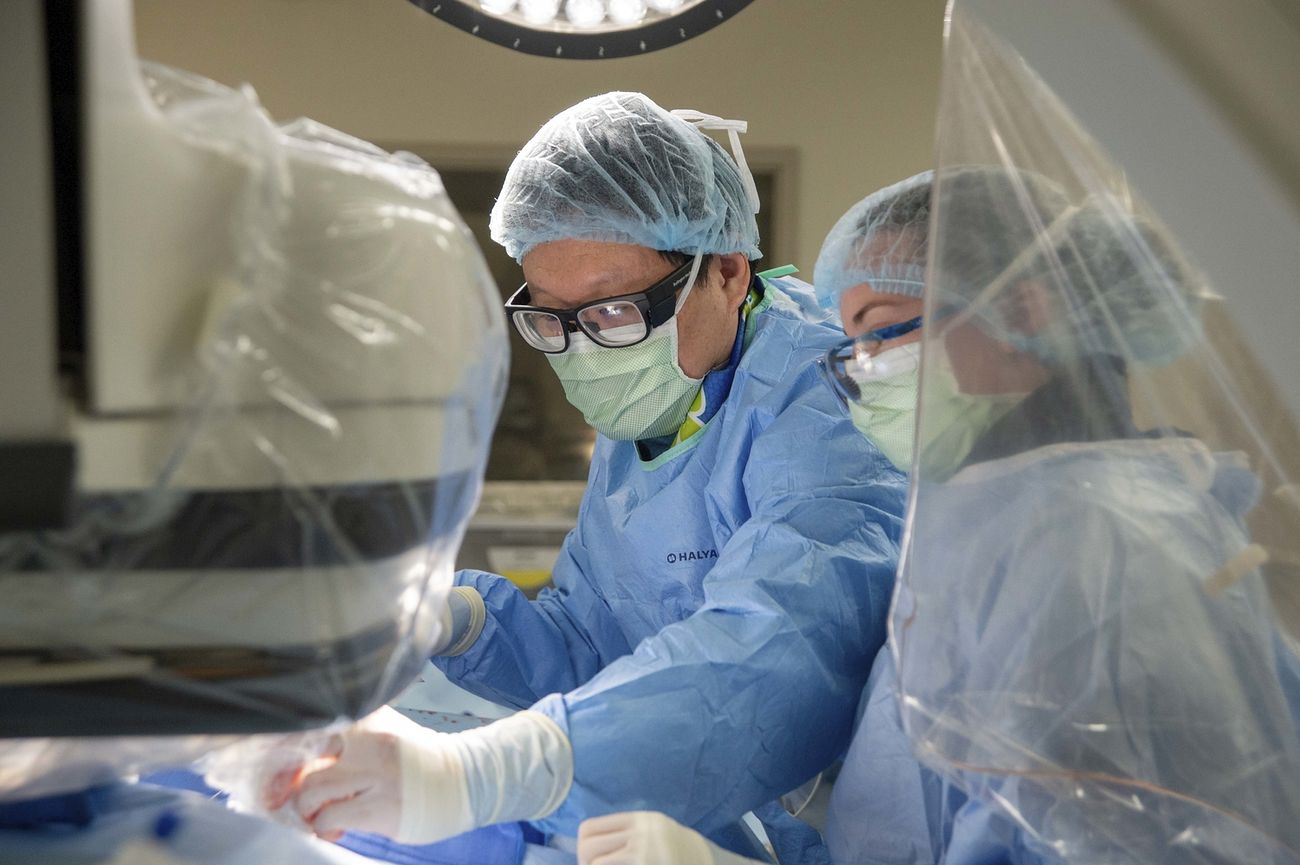
I’m in a beautiful waiting room in the Walter Tower of Methodist Hospital in Houston, Texas. I’ve been here since 7:15 this morning. I arrived early to get my husband prepped for a heart procedure at ten. The plan was to send a catheter from his groin, or his wrist, or both, into his veins and up to his heart where one of his arteries was totally blocked. If all worked well the calcium would come loose and a stent or two might be placed in that artery to keep it open. 

I waited with mostly older women whose husbands were undergoing different procedures with other doctors. Everyone tried to be upbeat and friendly as we strangers shared the common fears that go with such things. Each of us received a tentative probability of success. For my husband it was eighty five percent which sounds good, but the worrier in me looked at the fifteen percent chance of failure and I wondered if it would work at all, especially as the clock kept ticking from one hour to the next for close to four hours. 

People had come to the center made famous by Dr. Michael DeBakey, a trailblazer whose pupil Denton Cooley eventually performed the first heart transplant. They sat in tiny group in the large and airy waiting area sharing stories of their loved ones’ heart problems and the journeys that brought them to the Houston Medical Center. I found myself listening raptly and feeling fortunate that I live only twenty minutes away from the hospital and that the whole procedure had only cost one hundred dollars because my husband has a Medicare Advantage Plan. 

I wondered what people in small towns or without insurance do when they or a loved one has a serious heart defect. I found myself feeling good that my husband and I had been so careful during the height of the Covid pandemic. We took every vaccine that was available, religiously wore masks, and mostly stayed home. I worried about what would happen to my husband if he caught the virus. His oxygen level was never higher that ninety five even in the best conditions. His artery was blocked and he had already had a small stroke that luckily did not leave him handicapped. I had been like a police officer enforcing rules that I hope would keep him well until he was able to get that artery open. 

I thought about all of that while I waited. One hour, two hours, three hours, almost four passed. Most of the people who had been there with me had already heard about their loved ones and had left. I watched new people coming in for the afternoon appointments as the time inched toward three. Finally a nurse asked me to accompany her to a private room where the doctor would let me know how my husband had fared. She was kind enough to smile and assure me that it would be good news. 

I gathered my belongings, a laptop, a phone, some food and drink and followed the nurse like a little lost lamb. I was feeling shaky in spite of her insistence that all was well. I waited for the doctor to arrive and thought about the thousands and thousands of people in the Medical Center at that moment. Some were getting good news, some bad, some were dying. It was sobering to think about all of the humanity feeling so many different emotions in a single moment.

The doctor was confident and informative. He explained exactly what he had found and what he had done. He was happy to announce that the procedure was a success even though it had been more difficult than he had expected. He said that the blockage had been like concrete with no blood flowing through whatsoever. With patience and skill he and two other doctors were able to clear it completely and then install three stents. He said that blood immediately began flowing through the artery like a river that has been freed from a dam. I was elated and thanked the doctor profusely for his skill. I thought about all of the progress that has been made in healing hearts over the years. I realized that in another time my husband’s prognosis might have been very dire. It was a sobering thought. 

After a little wait I went to see how my husband was doing. He looked happy and he was filled with goals for eating healthy, losing weight and sticking to an exercise program. I now realized why he had so often been out of breath, having to stop walking long before he should have. He was already doing better with an oxygen level of 98 and a really good blood pressure. It seems that he and many others may have new leases on life from this one day. How many thousands of times are such stories repeated by doctors dedicated to saving lives? I have a former student who will soon be leaving for Stanford to do a fellowship in pediatric cardiology. He has already completed a residency at Texas Children’s Hospital. We will attend his farewell party with even more respect for what he has chosen to do. It’s remarkable to think that he may one day help a little one with a heart defect heal. I know how those parents will feel. I felt a roomful of emotions with my husband’s experience. We really do live in extraordinary times.

Ask Them What They Love

Ryuichi Sakamoto has died. In late March he succumbed to cancer. It is a great loss for the world. If you have not heard of Ryuichi Sakamoto, you have surely heard his music. It is some of the most beautiful ever composed. 

Sakamoto has captured emotions and elevated movies to Oscar worthy level with compositions that weave a tapestry of colors and artistry. While there is a hint of Asian influence in his themes, his works are universal. You may remember the haunting coda of Merry Christmas, Mr. Lawrence or the epic tones of The Last Emperor. In Wuthering Heights Sakamoto captured the possessive love of Heathcliff for Catherine with dramatic crescendos of piano and cello. The darkness of the music underpinning The Revenant heightens the pain and struggles of the hero. In fact, all of Sakamoto’s music is elemental, experimental and moving. 

Music is one of the inventions that seems to raise humanity to a place higher than the animal world. While birds sing and other creatures croon, It is humankind that that creates new sounds with instruments outside of their own voices. Sakamoto was a master at that. In fact he was one of the first composers to experiment with electronic sounds and different cadences in music. 

I sometimes hear people advocating for educations that only include practical majors. They poke fun at the arts, insisting that they are of little value to either the student or society. How ironic that during the Renaissance wealthy patrons supported painters, sculptors, writers and musicians. We herald that time as one of awakening and a leap forward in human progress and yet many today undervalue the very things that were encouraged during that time. 

I can’t imagine why we place higher values on some talents than others. We certainly need engineers, but it would be silly to have an overabundance of them and besides so many people are not the least bit interested in the kind of jobs that they do. Business is important as is medicine, but where would we be without music, plays, movies, books, paintings? Those are beautiful representations that humans have created from the most ancient times. It seems to be in our DNA to leave our imprint on the world with works of art. 

I have often found that the kind of people who complain about so called “useless” majors have never really attempted to become proficient in them or anything else for that matter. They droned away at jobs they disliked and dreamed of what they might have been. Studying any field is difficult and everyone of them serves purposes that we may not see unless we pay careful attention. For example a friend’s son majored in geography and was often taunted for choosing a subject that would only lead to a job teaching. In truth he found work with NASA because of his skills in understanding the impact of differing environments. His knowledge is essential in the future explorations of the universe and in the study of the impact of climate change. He has had no trouble finding a rewarding and meaningful career.

I was an English major with a mathematics minor. I ended up teaching mathematics for all of my time as an educator because schools had a shortage of people certified to teach math. I’ve had individuals tell me how smart I was to get a decent minor because an English major is worthless. I can think of nothing farther from the truth. Not only did I learn how to communicate in both formal writing and speech, but I realized the grandeur of the human mind as expressed in the words of plays, stories, books. I saw that linguistically words have a kind of mathematical logic. I have always believed that I was a better math teacher because of my English major than I would have been without it. 

We need everyone and we should not be on a rampage to eliminate the kind of learning that we rate as being less important than others. How dreary the world would be without is great variety! How wonderful that each of us has so many choices for living our lives? Inside every human there is a singular talent waiting to be free. Somewhere the next Ryuichi Sakamoto is banging on a toy piano and making beautiful sounds. A child with a great imagination and ability with words is already creating stories for his friends. The fingerpainting of a baby may lead to the work of a future Picasso. That child who soothes someone wounded by a bully may one day be a brilliant counselor. We should be encouraging them all to use their talents, not telling them that they are wasting their time.

Let’s be the patrons of this era. Let’s help all young people find and cultivate their passions. By inhibiting their enthusiasm we will most likely end up with a frustrated adult working at a joyless job. Let our young dream and strive for what makes them excited. Don’t suggest careers, instead ask them what they love. Therein is the key to a successful life. Nurture each person just as he or she wants to be.